
The idea in 60 seconds :
- Companies are starting to figure out use cases for LLMs to be applied to business.
- However, companies’ customers are consumers – and the way they consumers behave when LLMs are rolled out as conversational interfaces is going to be even more disruptive.
- Businesses need to focus on the way they integrate conversational interfaces with their websites.
- And invest in adapting the CX of the voice / screen experience their site provides.
- And enable eServices on their site so Assistants can engage with them.
- And then think through the ramifications for their strategies.
- There are no easy answers and some possibly negative outcomes.
Generative AI is a Change To The Way We Interact With The Internet.
Generative AI enables Conversational User Experiences. As we’ve seen, we will all soon have (increasingly autonomous) AI Assistants. For me, the fundamental question is , when everyone has a personal Assistant / Agent, how will the world change ? There appear to be 3 major changes which are imminent for businesses.
What Changes When We Do Everything Through an AI Assistant?
- Changes to Search Results: For the last 20 years, the top of the funnel for Digital Businesses has been search results. Now they’re evolving. It seems likely that our reliance on Search Results as they were will change and probably reduce.
- New User Experiences: Businesses are going to have to :
- Tie together conversational (voice + text) and visual screen experiences on their websites.
- Establish more engaging and personalized experiences.
- Businesses Will Enable Their Services On Their Websites As eServices : eServices are just company services which are available on the internet – things like ‘Open an account’, ‘Recharge my phone’ or ‘Buy pink jumper.’
Here is a bit more detail on each one of those.
- A Changes to Search Results.
The question here is – when we are all using conversational interfaces to AI Assistants, will that change what we search for and how we search online. One pre-cursor of the answer to that question lies in examining whether people use LLMs (Large Language Models like ChatGPT) differently to the way they used Google’s classic search box? The short answer is ‘yes’, which suggests that, as we move towards AI Assistants, what we search for and how we search will change materially.
With Google’s standard search box, people typically use keywords to search for specific information. Today’s LLMs (and therefore tomorrow’s AI Assistants) are able to understand and process information in a more nuanced way than traditional search engines. Results presented by an LLM / AI Assistant can be synthesized from multiple websites. That means people can ask LLMs / AI Assistants more open-ended and complex questions, and LLMs can generate more creative and informative responses.
Here are some examples of how people are already using LLMs differently to how they used to search :
- Asking questions about higher level, more abstract concepts: For example, someone might ask an LLM “What is the meaning of life?” or “What is the nature of consciousness?” Bing Chat sometimes does 30 searches to find information in response to a question I ask of it and synthesizes the results.
- Generating creative text formats: LLMs can be used to generate poems, code, scripts, musical pieces, email, letters, etc.
- Translating languages: LLMs can translate text from one language to another.
- Summarizing text: LLMs can summarize long pieces of text into shorter, more concise summaries.
- Answering questions from documents: LLMs can answer questions about documents, even if the answers to the questions asked were not asked explicitly in the documents.
| Feature | LLMs | Google Search |
| Input | Open-ended, complex questions | Keywords |
| Output | Creative, informative responses | Links to relevant websites |
| Underlying technology | Artificial intelligence | Search engine algorithm |
| Strengths | Understanding and processing information in a nuanced way | Retrieving information from the web |
| Weaknesses | Can be biased or inaccurate | Can be difficult to use for open-ended questions |
Of course, we could still search as we have done for the last 20 years and ADD new questions of our AI Assistants. However, it seems credible to think that search results are going to change, probably dramatically over time, as people ask their Assistants (Link to article 3) questions instead of Googling them. That’s a significant change in behavior which will affect Google and any online business.
For as long as anyone can remember, it’s been sitting at the top of Google’s search results which made or broken a digital business. It could be that’s about to change.
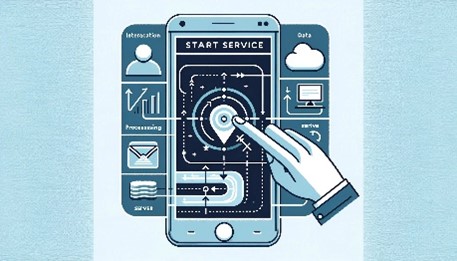
Instead of searching for what we want, we are likely to start asking LLMs to solve more abstract problems from our phones.
New User Experiences: Businesses are going to have to :
- Establish more engaging and personalized experiences.
When we are using AI Assistants to solve our problems, the way we interact with websites will change.
Having figured out how to deal with mobile and responsive designs, companies are now going to have to reinvent their experiences again.
- Tie together Conversational ( voice / text) and screen experiences.
Additionally, businesses are going to have to provide their human users expect a coordinated Conversational (voice / text) interaction.
- Some interactions are entirely appropriate for Voice User Interfaces.
- On an eCommerce site : “Do you like this dress?”
- On a website for bathroom tiles “Which pattern is best?”
- Some interactions are not appropriate for Voice Interactions in public.
- “Would you like to see your current bank balance?”
- “Your girlfriend just sent you a personal message or image. Shall I describe it?”
- “Would you like me to read your search history out loud?”
But it will no longer simply be humans visiting company websites. Soon, many of the visitors which come to a site are going to be AI Assistants acting on behalf of their user.
- Establish more engaging and personalized experiences.
As I covered in a previous article, phones know a lot about you. How well you slept, who you flirt with, what your favorite TV shows are and so on and so on. People will come to expect higher levels of relevance and personalization on the sites they visit.
- Businesses Will Enable Their Services On Their Websites As eServices
At the moment, we take some things for granted, including the fact that visitors to our websites are mostly human. There are some ‘bots’ but generally that is seen as unhelpful traffic.
When conversational interfaces roll out, much of the traffic which visits a businesses website may no longer be a human user. It will be the user’s Assistant / Agent. The question then is – how can you help the user / his Assistant achieve their goal (your commercial outcome) on your website?
I think this is the most important step for businesses. They are going to have to enable everything they do online as an eService that Assistants / Agents can plug in to. By “Plug in”, I mean businesses need to allow Assistants / Agents to or integrate with their websites and the services they offer on that website. This facility, enabling eServices, allows the agent to access and use the functionality of those other systems, such as sending emails, making payments, or booking appointments.
When Open AI, Samsung, Apple and all the others launch their new voice enabled assistants, I suspect that they will also specify principals for APIs that the Assistants can work. The implications for existing businesses are substantial. It involves not only technical upgrades but also a rethinking of how consumer interactions are handled in an increasingly AI-integrated market.
If you’re interested, I have some ideas here for how to develop eServices for an existing site.
In the End, Who Owns The Customer? What Brands Matter?
Some of these implications (companies needing to enable eServices on their websites) have been around for a while. I wrote about all of them in 2016 when voice searches were taking off. They later plateaued and never quite reached the heights anticipated. However, LLMs now make it relatively easy for people to have conversational interactions with the internet.’
Admittedly, this is a complicated circumstance. There are a lot of moving parts which makes it difficult to predict what’s coming next.
Businesses which rely on their position in search results are likely to see the most immediate negative impacts from the change to using LLMs to solve problems instead of Google. Aggregators and comparison sites, for example.
Redesigning experiences for voice and screen interactions could be a significant job and it affects a great deal. For example, it has always been much easier to hide the things you don’t want your customers to know in the terms and conditions. That will now be harder. It’s likely users’ Assistant / Agent will review terms and conditions for you and point out the nasties hidden therein.
Separately, redesigning the experience visitors to your site have across voice and visuals will be expensive – and it will only serve the proportion of traffic coming to the site which is human.
And then there’s the eService side of things. Not building the eServices represents a risk for every existing digital only business, proportional to their digital scale. What I mean is – if you are a digital only company – you only exist online – and you do not enable your Evaluate, Buy and Self service, you’ll lose a proportion of your business – that which is now administered by Assistants / Agents.
And that is not the end point. In the short term, if you don’t enable Assistants / Agents to access your services, they may keep moving and go to a competitor that will. In the long run, businesses enabling everything they do as an eService available to Assistants and Agents are a little like a Turkeys voting for Xmas. Turning on those eServices could allow the Assistant / Agent to disintermediate your brand altogether. For example, do you really need to know what phone network or private health care provider or bank you’re with if your assistant can sort those things out and get you the coverage / mortgage interest rate / Extras cover you need at the best cost and your Assistant just sorts it all out?
The results will be so disruptive, it’s possible website owners won’t allow it.
 Neil Aitken - Blog