- AI will make some people unemployed. I’m sure we agree.
- But it can also help fix the problem it creates.
- It can identify future job demands, assessing displaced workers’ skills, and helping with personalised reskilling and job placement.
- We already have reports showing how AI analyses labour market trends to forecast in-demand roles and skills.
- These could be used so that reskilling efforts are targeted towards industries the future needs, like technology, healthcare, and renewable energy.
- AI can create tailored, adaptive learning plans based on individual skill profiles, addressing gaps but also using existing (including latent) strengths to accelerate workforce readiness.
- AI-powered platforms can be used to deliver personalised digital and in-class training, using simulations and adaptive learning techniques to improve skill acquisition and inclusivity.
- Further down the line, AI can be used to match skilled workers to suitable roles, reduces hiring biases, and provides ongoing support through performance monitoring and on-the-job training tools.
- It’s hard to argue against proactive investment in an AI-driven workforce strategy like this. It reduces unemployment, improves equity, and unlocks significant economic growth.
- Inaction risks higher welfare costs, inequality, and social unrest.
Using AI for Workforce Transition
AI will displace workers and create new jobs. I’m sure we agree. The Jobs and Skills department of the Australian government issued a very good report in August 2025 on the impacts of Generative AI, in part on the workforce. To their credit, they recognise the situation when it comes to displaced people and know they have to deal with it. This article is my proposal on how they could.
AI can be used at every stage of the transition, to proactively mitigate the economic and social costs of displacement.
I’ve broken it down, here, in to a six-step framework for workforce transition, detailing how AI can identify new economy jobs, evaluate displaced workers’ skills, and facilitate personalised reskilling and job placement.
It also examines the economic trade-offs and human impacts of inaction versus intervention. There are some big $ number implications for Australia and a human aspect that we shouldn’t forget.
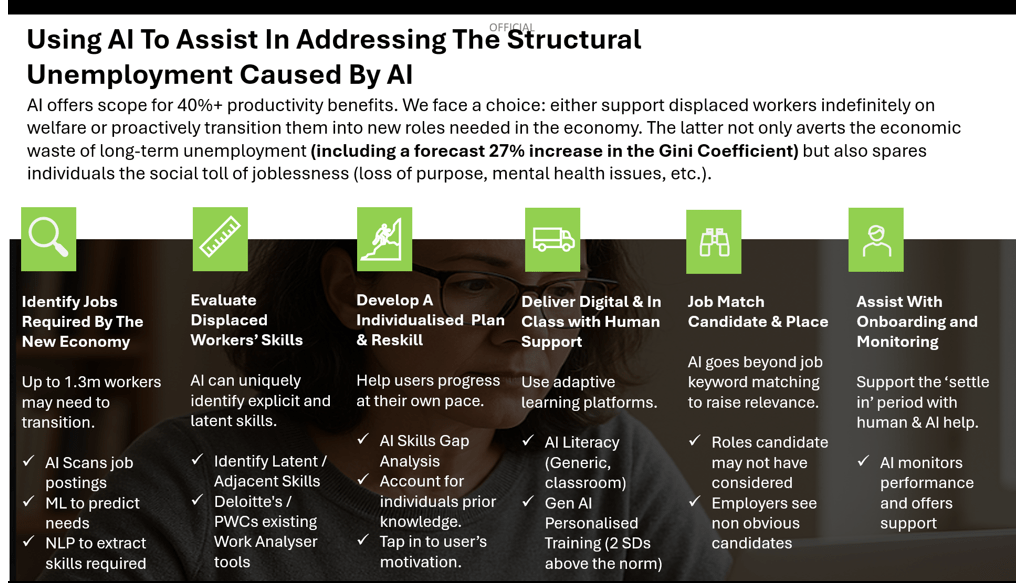
AI can be used to solve the structural unemployment problems it will likely create. You just don’t hear it spoken about a lot.
1. Identifying Jobs Required by the New Economy
The first step is identifying roles and skills that will be in demand in the evolving economy. AI is already used to analyse labour market trends and forecasting future workforce needs. Natural Language Processing (NLP) can extract detailed skill requirements from job postings and industry reports, while machine learning models predict workforce needs based on economic and industry trends.
For instance, Deloitte’s Work Analyser tool uses AI to assess the impact of automation on specific tasks and roles, offering insights into employment changes. This enables policymakers and training providers to focus on roles with genuine demand, such as those in technology, healthcare, and renewable energy.
We want to reassign people in to jobs the economy needs and we’re already halfway there on this one.
2. Evaluating Displaced Workers’ Skills
Once target roles are identified, the next step is assessing the skills and capabilities of displaced workers. AI can evaluate both explicit skills (e.g., technical abilities) and latent skills (e.g., transferable capabilities implied by experience).
AI tools could be used to analyse resumes, career histories, and performance data to infer explicit skills. For example, a taxi driver’s navigation and customer service skills may be transferable to logistics or courier services.
Psychometric data can also be incorporated to evaluate soft skills like problem-solving and communication. AI-driven simulations provide a nuanced understanding of workers’ strengths and areas for development. Generative AI is really good for this as I’ve written about before.
By focusing on both technical and soft skills, AI can help make sure that a (potential) workers’ full potential is recognised. It’s fairer and more likely to put someone in to the right job.
3. Developing Personalised Reskilling Plans
There aren’t many off the shelf tools which do the job of training, as things stand. Theoretically, AI enables the creation of tailored reskilling pathways based on individual skill profiles and career goals.
Equipped with a skills gap analysis, AI-powered platforms like Rise Up can generate personalised learning plans, breaking down curricula into bite-sized modules tailored to the learner’s pace and needs.
These plans are dynamic and adaptive. As workers progress, AI systems monitor their performance and adjust learning pathways in real-time, so they’re relevant and effective.
Personalising things in this way is likely to keep workers engaged and motivated, accelerating their transition into new roles.
4. Delivering Digital and In-Class Training
Training delivery is critical to workforce transition. AI enhances both classroom-based and digital learning experiences, ensuring workers acquire the skills needed for new economy roles.
Classroom programs can focus on foundational AI literacy, while generative AI offers the potential to deliver personalised digital training. Adaptive learning platforms tailor content to individual skill levels, using techniques like spaced repetition and interactive simulations to enhance retention.
AI systems can adapt training content for different literacy levels or languages, ensuring inclusivity for disadvantaged groups. LLMs themselves are adding this capability. OpenAI added ‘Study Mode’ to their core LLM recently. Correctly prompted, any LLM can already do a pretty good job. I can see this market being flooded in a year.
I’m designing some training at the moment and I would love to have a Generative AI Training tool like this. My view is that it wont be long before there are plenty.
5. Job Matching and Placement
After reskilling, the next step is matching candidates to suitable roles. AI-powered platforms like Sapia.ai and Vervoe use machine learning to match candidates to roles based on skills, competencies, and potential, rather than demographic proxies. They’re still in their early stages but they show promise.
And this is where the rubber hits the road. We’re using everything we know about the candidate, their job history, latent skills, the new skills they’ve learned and applying it to an actual job the economy needs. A nerdy economist might say that’s really cool.
6. Onboarding and Continuous Monitoring
The final step is ensuring a smooth onboarding process and providing ongoing support. AI facilitates on-the-job training and monitors performance, enabling workers to adapt quickly to new roles. I happen to know some guys doing credible Generative AI work in this space personally (Cuhshi).
If you wanted to be sensible about it, you could use AI-driven micro-learning modules address specific knowledge gaps as they arise and performance monitoring systems track key performance indicators (KPIs) and provide real-time feedback. For instance, an AI mentor chatbot could answer questions anonymously, reducing onboarding friction and fostering confidence.
It’ All Sounds Expensive. Why Should We Do It?
There are lots of facts and figures around. Here is a quick summary which I propose we use directionally. i.e. it’s probably wrong but it might be indicative of the net effect of automation.
- Automation is expected to displace approximately 1.3 million workers in Australia (Business Council of Australia, 2024).
- Through proactive reskilling and job placement efforts, around 700,000 of these displaced workers could be reassigned to new roles.
- AI and automation projected to create 200,000 new jobs by 2030, particularly in AI-related and emerging industries (Tech Council of Australia, 2024).
- Combining : The net effect is a decline of approximately 400,000 jobs (1.3 million displaced – 700,000 reassigned – 200,000 new jobs created).
So, 1.3m people displaced, of which 700k need to be reassigned and 200k trained for new jobs.
What that means is, there’s no – no cost option. The choice is only between proactive investment in reskilling or reactive spending on welfare and social consequences.
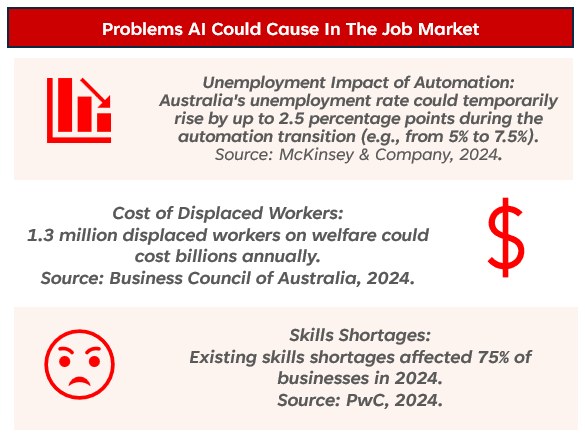
It’s quite well known that AI could have some negative impacts on the job market.
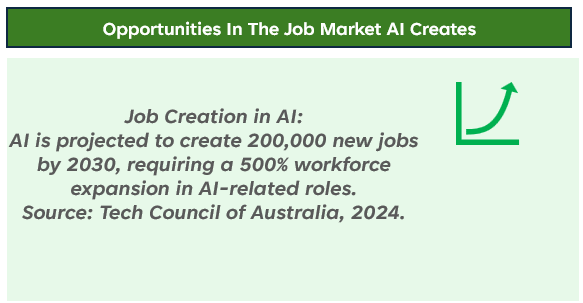
It will also create jobs although the insights suggest the net will be negative.
Human Impacts
The human benefits of proactive workforce transition are a big deal, too. Re-employment improves mental well-being, reversing the detrimental effects of long-term unemployment, such as depression and social isolation. Purposeful work creates a sense of identity and community, reducing crime rates and family tensions.
Targeted reskilling initiatives also promote equity, ensuring vulnerable groups are not left behind in the AI-driven economy. For example, automation disproportionately impacts lower-income earners and women, exacerbating social inequalities. Proactive intervention can mitigate these effects, creating a more inclusive labour market.
It’s Already Happening – Let’s Use AI To Fix It
Lots of facts and figures. The net net is forecasts at this stage predict an overall loss of 400k jobs.
Early, recent reports have started to show, credibly, that the number of entry level jobs are already being affected by Generative AI. A whole generation has started giving up.
AI already offers powerful tools to navigate workforce transitions, from identifying future roles to reskilling and job placement. Proactive investment in AI-driven workforce strategies is not just an economic imperative but a social one.
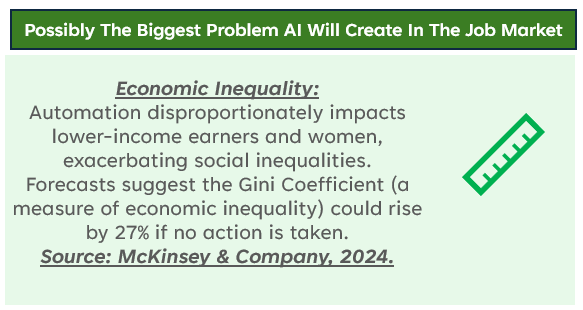
To me, this is the biggest risk. Income inequality is the source of almost all negative social outcomes.
With some proactivity, Australia can build a resilient, inclusive workforce ready to thrive in the AI-driven economy. The alternative, inaction, risks exacerbating unemployment, inequality, and social unrest. It appears to be a no brainer.
 Neil Aitken - Blog