60-Second Summary: 6 Key AI Trends in 2025
- Investment: Global AI funding surged 48% in 2024, but Australia’s share remains modest (A$0.7B). Focus on measurable outcomes and readiness to act when funding arises.
- Regulation: Tightening laws (e.g., ISO 42001) demand transparency and accountability. Build governance frameworks early to ensure compliance and mitigate risks like bias.
- Embedded AI: By 2026, 80% of enterprise apps will include AI. Audit software for hidden AI components, demand vendor transparency, and monitor for bias or drift.
- Generative AI: 80% of projects fail due to poor ROI and overhyped expectations. Experiment with prototypes and prioritise fast ROI use cases.
- Agentic AI: Overhyped but promising. Focus on proven solutions and monitor developments cautiously.
- Workforce Changes: AI displaces roles but creates upskilling opportunities. Invest in AI literacy training and redeployment strategies (e.g., QPS’s QChat pilot).
The 6 Key AI Trends
LinkedIN is full of content related to AI. I think there are six key trends are emerging that reflect the real things to focus on, for anyone working in AI. Some of them (like Embedded AI) seem to be largely ignored. These trends highlight both the opportunities and the risks of AI adoption, this is what we should consider in our planning.
1. Investment: The Accelerator Pedal.
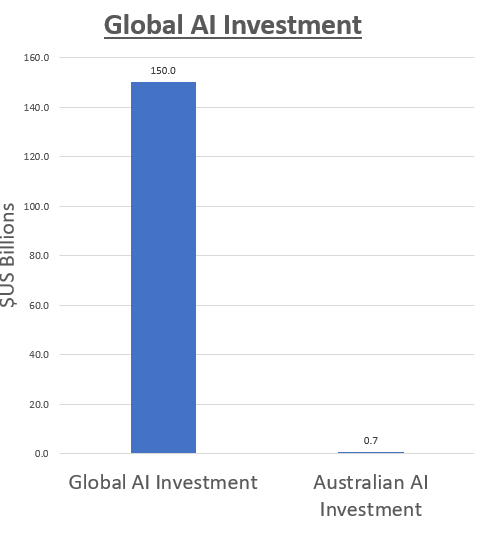
AI investment is surging globally, with a 48% increase in 2024 alone, largely driven by enthusiasm for generative AI. However, Australia’s share of this funding remains modest. You might say it’s directionally correct and functionally trivial. We’re investing just A$0.7 billion in private investment last year. For AI practitioners, this means competition for resources is fierce, and demonstrating ROI is more critical than ever.
Implication:
- We should focus on projects with clear, measurable outcomes to secure funding.
- Be prepared to act quickly when opportunities arise, as organisations with established procurement processes will have an edge.
We’ve put together, through our procurement process, a delivery panel of Systems Integrators to ensure readiness for future AI funding. This allows us to prioritise projects that deliver immediate benefits, such as reducing admin burdens for frontline officers when money becomes available. In the meantime, we’re experimenting to learn lessons we can apply. See below.
2. Regulation: The Brake.
AI regulation is tightening worldwide, with Australia set to introduce new legislation in 2025. These laws, likely based on ISO 42001 will focus on transparency, accountability, and risk management, particularly for high-risk AI systems. For practitioners, this means navigating a more complex regulatory landscape while ensuring compliance.
Implication:
- Build governance frameworks early, including policies, risk assessments, and oversight boards.
- Prioritise transparency and explainability in AI models to align with emerging regulations.
We’ve put in place a governance framework that includes an AI Policy, Governance Board, and Foundational AI Risk Assessments (FAIRAs). To the degree possible, this ensures compliance with upcoming legislation while mitigating risks like bias and lack of transparency.
3. Embedded AI: Productivity While Managing Risk
Embedded AI, where AI is integrated into everyday software and systems is coming in from every software provider in the next couple of years. As I’ve said before in this blog, by 2026, 80% of enterprise applications are expected to include AI features. However, this trend comes with hidden risks, as vendors often embed AI without clear disclosure, shifting liability to buyers.
Implication:
- Audit software for embedded AI components and demand transparency from vendors.
- Implement monitoring systems to detect issues like bias or model drift over time.
We’re putting together a plan on this. Auditing all of our software with procurement to find out what has AI embedded and mandating AI clauses in contracts to ensure vendors disclose AI features.
4. Generative AI: High Potential, High Risk
Generative AI continues to dominate headlines, but 80% of projects fail to progress beyond the pilot stage due to poor ROI measurement and overhyped expectations. For practitioners, this highlights the importance of disciplined project management and a focus on real-world applications.
Implication:
- Experiment with prototypes to learn from failures and refine your approach.
- Prioritise use cases with clear, fast ROI to build credibility and secure buy-in.
We’re experimenting with generative AI MVPs & prototypes to prepare for future builds. By focusing on QPS-specific tools with fast ROI, they aim to avoid the pitfalls that have plagued other organisations.
5. Agentic AI: Hype Today, Promise Tomorrow
Agentic AI is everywhere. We’re promised systems capable of goal-oriented actions. It’s being hyped as a step toward Artificial General Intelligence (AGI). However, practical applications remain limited, and most projects are still experimental.
Implication:
- Approach agentic AI with caution, focusing on proven solutions rather than speculative projects.
- Monitor developments closely to identify opportunities as the technology matures.
We’re taking a measured approach to agentic AI, monitoring developments and remaining open to adoption when solutions deliver measurable productivity benefits. For now, I consider it hype.
6. Workforce Changes: Empowering and Redeploying Staff
AI will inevitably displace some roles, but it also creates opportunities to redeploy staff to higher-value work. For practitioners, this means balancing automation with upskilling and workforce engagement.
Implication:
- Invest in AI literacy training to empower staff and reduce resistance to change.
- Develop retraining and redeployment strategies to ensure staff remain engaged and productive.
QPS is piloting AI literacy training for frontline officers, starting with a Queensland Government LLM called QChat. This initiative aims to reduce admin burdens, potentially returning the equivalent of 2,000 officers to the frontline.
Final Thoughts: Navigating the AI Landscape in 2025
These six trends highlight the dual nature of AI: its potential to transform industries with much better productivity, and its capacity to introduce new risks. For people in the field, the key is to stay informed, act responsibly, and focus on delivering measurable value. Whether we’re building generative AI tools, auditing embedded systems, or preparing for regulatory changes, the decisions we make today will shape the future of AI adoption in your organisation.
 Neil Aitken - Blog