
The Idea in 60 Seconds
- Large Language Models (LLMs) like ChatGPT can increase productivity by 40%–50%.
- The financial benefits of these productivity improvements will flow, first to chip manufacturers and then on to software vendors.
- Why? The ROI companies enjoy from AI software justifies the subscription fees they charge. Software vendors will charge higher recurring monthly fees as AI tools prove their value through measurable time savings which provide an ROI.
- The first wave of this growth is happening in chip manufacturers like NVIDIA. Soon it will be followed by software vendors embedding AI into their products.
- We have started to see evidence of this change : Gartner predicts that 80% of enterprise software will have embedded AI by 2026, reshaping the global software market. (See charts below.)
- Personal Take: (This is not financial advice.) I’ve invested in the NASDAQ, betting on companies like Alphabet, Amazon, and Microsoft, which are leading the charge in integrating AI into their offerings precisely for this reason.
The Simple Facts
There’s a simple fact that often goes unnoticed amid the hype about artificial intelligence (AI) is that the productivity benefits of AI will initially flow to AI chip manufacturers like NVIDIA and then on to software vendors. Ultimately, the share prices of the major software companies will reflect these productivity gains, multiplied through their price-to-earnings (P/E) ratios.
Credible insights suggest that, when measured scientifically, Large Language Models (LLMs) like ChatGPT can boost productivity by as much as 40%–50%. Personally, I use an LLM daily, and I’d estimate it has had a similar impact on my own productivity.
The Relationship Between Productivity and ROI
Back in 2009, I was the BlackBerry Product Manager for Vodafone UK. At the time, Research In Motion (RIM), the company behind BlackBerry, would offer businesses a free trial and measure the productivity benefits of their software to encourage uptake. Independent research by IPSOS Reid, at the time, performed on companies which did this trial, found that the average BlackBerry user saved 47 minutes per day. RIM charged £30 per month for the service, a price justified by the time savings it delivered. The ROI the software created justified the monthly service fee.
Fast forward to today, and we see a similar approach with Microsoft’s rollout of CoPilot to (already) more than 150,000 enterprise customers. With this rollout, Microsoft included a ‘free’ KPMG productivity study as part of the experiment. Of course, it showed an ROI and justified the additional fees for CoPilot, just like RIM did.
The Relationship Between ROI and Recurring Monthly Service Fees
Mostly, these days, software tools are offered as recurring monthly services. The individual user gets the productivity benefits, and the software vendor captures the ROI through subscription fees.
This dynamic is already reshaping the market. For example:
- Chip Manufacturers:
The first wave of share price growth is being seen in companies like NVIDIA, which produce the chips needed to develop and scale AI models. Their rapid growth reflects the fundamental role they play in the AI ecosystem. Foundation models and anyone selling AI software need these chips to develop their services. This is an upfront investment by the software providers in the hardware they need to make their services. - Software Vendors:
Next, software vendors will release AI-enhanced products with monthly recurring fees that reflect the ROI they deliver to users. This is already happening and it will now accelerate. I’ve included some charts below to show how fast these AI enabled apps are rolling out. - AI Developers:
Finally, companies like OpenAI and Anthropic will release advanced personal assistants capable of executing complex tasks on our behalf, further shifting value to them. This is the final stage of AI adoption and it’s a big subject I will return to in future blog articles.
For investors, the NASDAQ appears to be the place to watch over the next few years as these productivity benefits flow through the economy. Don’t get me wrong, every business will benefit from the productivity increases – it’s just that the money will flow disproportionately to the software providers who get a proportion of the productivity improvements from every enterprise who rolls them out.
Evidence to Support the Claim: Forecasts
Gartner forecasts fast growth in enterprise AI software investment, with every vendor scrambling to integrate LLMs into their offerings.
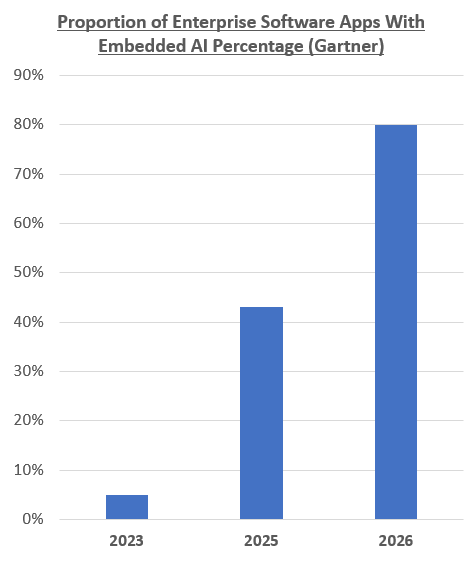
Gartner predicts that 80% of enterprise software will have embedded AI by 2026.
Currently, AI software represents only about 10% of the total software market. However, AI software is growing at about 20% per year, regular software at about 10%.
The global software market is expanding rapidly, driven in part by the integration of AI.
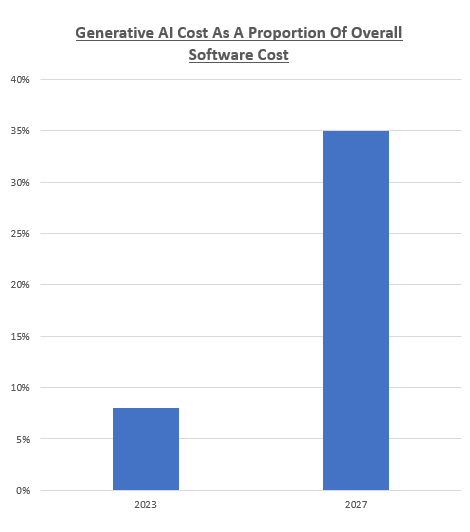
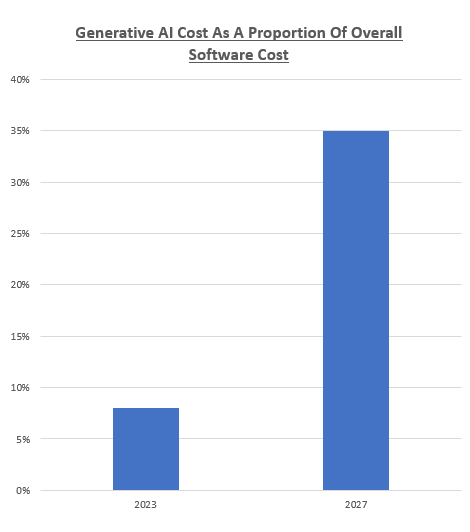
Generative AI is accounting for an increasing proportion of overall software costs.
In Conclusion
This article reflects my personal beliefs and observations. It is not financial advice. That said, I’ve moved a significant portion of my personal SMSF (Self-Managed Super Fund) into the NASDAQ. I believe companies integrating AI into their software, including the so-called ‘Magnificent 7’, Alphabet (Google), Amazon, Apple, Meta (Facebook), and others, will:
- Improve productivity,
- Charge higher monthly service fees, and
- See these benefits disproportionately reflected in their share prices.
 Neil Aitken - Blog