The idea in 60 seconds
- Large Language Models (LLMs) are tools like ChatGPT.
- The research suggests that they can help users be far more productive on some work tasks when they use an LLM as a colleague.
- Some users already employ LLMs constantly, alongside their jobs.
- I’ve experienced those benefits myself.
- Users seem to follow a standard progression through 5 stages of their engagement with LLMs.
- I’ve mapped them out as a way of providing a map towards the productivity benefits AI offer.
How Do We Help People Get The Productivity Benefits of AI ?
LLMs are Large Language Models like ChatGPT.
Credible evidence from a number of sources shows that the productivity benefits associated with people using LLMs in their jobs, are substantial. Studies show potential benefits typically between 25% and 40%.
That’s an enormous, organisation, economy transforming number. As I’ve said before in this blog, a good year for Australian productivity growth is 1%. AI offers the promise of an order of magnitude more. Productivity is extremely important. To individuals, it can mean higher real wages, to companies, higher profits and to the government, more tax receipts.
The problem is, for many people who are just starting out, it’s hard to know how to skill themselves up to the point they can secure them.
How Do We help people use LLMs in more advanced ways?
This is a subject I’m passionate about. I’ve seen how LLMs can improve productivity with my own eyes. I now think of how I can use an LLM first, whenever I’m given a substantial task.
In work I use our local LLM, ‘Qchat’, as a patient colleague, kicking the ball around on day to day jobs. Outside work, I have a paid subscription to ChatGPT, which I use for everything from simple searches to self development.
Because I work in AI, almost every day, someone will tell me how they use ChatGPT. I started to notice a trend. There are different types of user, from those just starting out who use it for simple tasks and more advanced users who integrate the tool more effectively in to their job lists.
I wrote, recently, about how younger people are streaking ahead in their use of LLMs, sharing more personal information with it and, in exchange, learning its capabilities. It made me think – how can I help older people do the same?
Many people Don’t Know Where to Start
It’s the same with any technology. If you just send a link out to the tool, people have no concept of where to start. Where young people, driven by a desire to develop themselves and perhaps less fettered with uncertainty around new technology have found there own way, if we’re to support older users in securing the same benefit, we need a structured path to show them.
The LLM User Maturity Framework
I developed this progression with ChatGPT on the weekend, asking it what different types of user engaged with it. It estimated different proportions of user at each stage of sophistication. (Obviously it could have hallucinated these, I have no way to check but on the face of it these seem like reasonable estimates.)
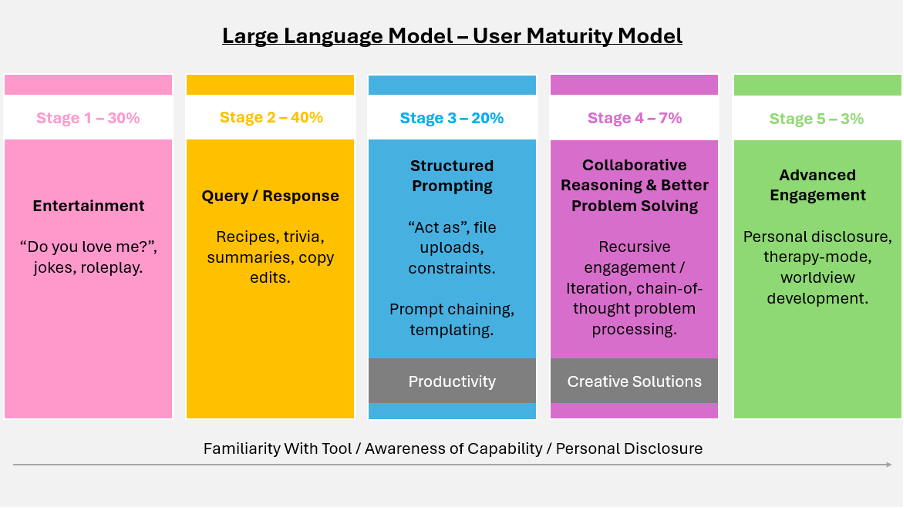
Understanding the steps users go through when evolving from a new user of LLMs to an advanced user can help people understand what they need to do to progress.
The benefit of understanding the problem in this way is that it helps us define specific ‘challenges we can set users at each level which will help them access an understanding of what LLMs can do at the next level. I will outline how users can level up through these evolutionary changes in the next article.
In Conclusion
We are sitting on a productivity bounty, but we don’t know how to get to it. This User Maturity Framework provides guidance on how we can give users a map and help them understand what’s possible with these tools.
In the following articles, I will explain first, the structure of user progression and then detail the specific exercises users can undertake to move through the progression themselves.
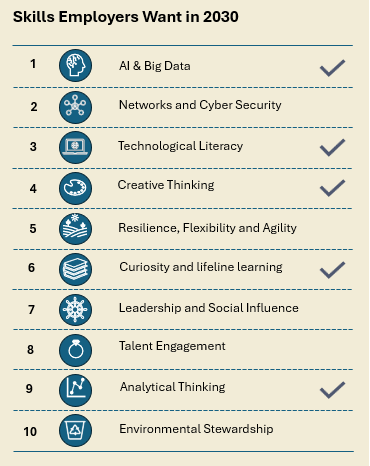
The WEF have produced a list of the skills they think employers will expect from employees in 2030. Engaging with LLMs as a co-worker, alone, can help you develop 5 of them.
 Neil Aitken - Blog