The Idea In 60 Seconds
- This article outlines the process LLM users can take to go from being a total beginner to an advanced user of LLMs.
- It explains the 2 primary differences between each stage of use : The information you disclose to the LLM and what you understand about it’s capabilities.
- It outlines the pathway you can follow to evolve your LLM use.
- On the way, you’ll find out how to garner the productivity benefits these tools can provide you.
- Explain how LLMs can make you more creative in finding unique solutons to the problems you’re addressing at work.
- And they ways your thinking about what’s possible will change on the way.
Unlocking the Full Potential of LLMs: How to Level Up Your Skills
Large Language Models (LLMs) like ChatGPT are powerful tools, but their true potential isn’t unlocked by simply asking them to write a joke or summarise a document. In the last article, I outlined the five stages of LLM usage that individuals typically progress through. These stages represent a journey from basic use to advanced collaboration and creativity.
To fully benefit from these tools, users need to evolve their approach, moving deliberately from one stage to the next. Progression through each stage involves you internalising some key concepts. You’ll be sharing more information to help the LLM help you and you’ll be impriving your understanding of the tool’s capabilities.
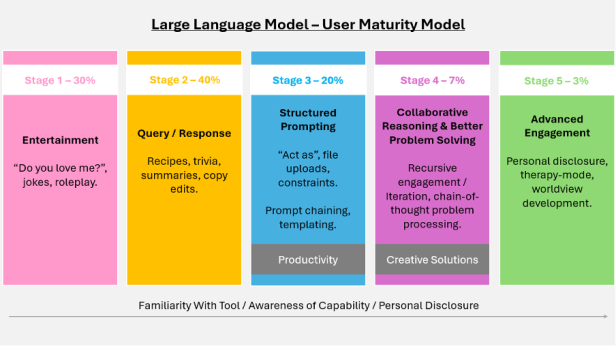
This article outlines how LLM users can go from their first tentative steps to advanced user.
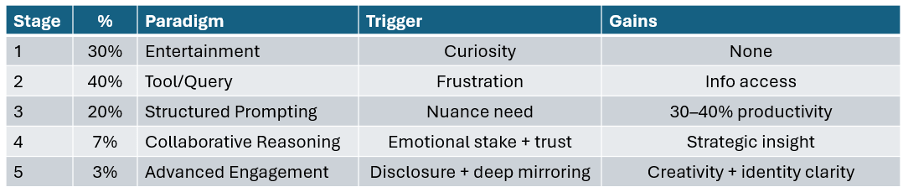
These are the 5 stages through which LLM users evolve with some estimated percentages of the number of users who are in each stage.
Two Frontiers of Growth: Disclosure and Comprehension
Most corporate AI training programs, focus on the mechanics of prompt engineering. Typically, courses involve teaching users how to phrase questions or commands to get better outputs. While this is useful, it’s surface-level and transactional.
This approach is different. It’s about helping users like you adopt mindset shifts that fundamentally change how they engage with LLMs. You are evolving how you think, what you share, and starting to collaborate with these tools to get your work done.
At its core, moving up the LLM User Maturity Framework requires users to develop the way they work with these tools on two key frontiers:
- Disclosure: What you’re willing to share with the LLM. As you progress, you’ll need to provide more context, detail, and even, for those that wish to develop themselves as well as pursue the productivity benefits, personal information. This additional information will help you to unlock deeper insights and more meaningful outputs.
- Comprehension:
How deeply you understand what the LLM can do and how to guide it effectively.
Why Progression Matters
Here’s why this progression is so important:
- It shows you how to progress.
- Unlike prompt engineering course, this model provides the specific elements of mental growth you will have to go through to get the benefits. It gives you a structured pathway which will allow you to do it.
- It Balances Productivity with Creativity:
- Productivity is often the focus of AI training—how to save time, automate tasks, or improve accuracy.
- But creativity is where LLMs can have the most transformative impact, especially for more senior leaders.
- By teaching users how to engage in collaborative reasoning and explore new ideas, this framework unlocks benefits that go far beyond simple task automation.
- It Builds Trust and Confidence – In Yourself:
- Many users hesitate to fully engage with LLMs because they worry about errors, privacy, or over-reliance.
- By addressing these concerns and teaching users how to build trust in the tool, the framework encourages deeper and more meaningful engagement.
- Tailored to Roles and Goals:
- Different users have different needs.
- For individual contributors, the focus is on structured prompting and productivity.
- For senior leaders, the focus is on collaborative reasoning and creativity.
- Collaboration, Not Just Commands – Kicking The Ball Around With Your LLM
- Prompt engineering is often taught as a one-way interaction—users give commands, and the LLM responds.
- This framework emphasises collaboration, where the LLM becomes a thinking partner. Users learn to engage in iterative dialogues, test hypotheses, and co-create solutions.
How the Framework Operates
In the following articles, I’ll break down each element of a successful user transition between stages of LLM use, in detail, covering:
- Mindset: The mental shift required to move to the next stage.
- Disclosure: What kinds of information you need to share to unlock the next level.
- Comprehension: How to better understand and guide the LLM.
- Why Move Up: The benefits of progressing to the next stage.
- Natural Concerns: Common fears or hesitations and how to address them.
- Challenge: A practical exercise you can undertake yourself to help you take the next step.
- Example Interactions : Specific prompts to try at the next stage.
Key Things to Remember
As you progress through the framework, keep these points in mind:
- You Can’t Break It:
Experiment freely—LLMs are designed to handle all kinds of inputs. The worst that can happen is you’ll get an unexpected response, which is just an opportunity to refine your prompt. - It’s a Learning Process:
Every interaction is a chance to learn. If the output isn’t perfect, adjust your prompt, add more context, or try a different approach. - It’s Okay to Start Small:
You don’t have to dive into complex tasks right away. Start with simple, practical requests and build confidence as you go. - You’re Still in Control:
The LLM is a tool, not a decision-maker. Use it to generate ideas, test hypotheses, or explore possibilities—but remember, the final decision is yours.
Final Thoughts
The LLM User Maturity Framework is about evolving how you think, share, and collaborate with tools like ChatGPT. By focusing on progression, mindset shifts, and tailored training, this approach helps users like you unlock the full potential of LLMs, from total beginner to productivity gains to transformative creativity.
In the next article, we’ll dive into the first transition: moving from Stage 2 (Tool/Query) to Stage 3 (Structured Prompting). Stay tuned for practical steps, challenges, and prompts to help you take the next step in your AI journey.
 Neil Aitken - Blog