The Idea in 60 Seconds
- In the last article, we explored how to move from Stage 2 (Tool/Query) to Stage 3 (Structured Prompting), unlocking the ability to handle complex, multi-step workflows.
- This article focuses on the transition from Stage 3 (Structured Prompting) to Stage 4 (Collaborative Reasoning), where the LLM becomes more than a tool – it becomes a thinking partner.
- More senior leaders and professionals are often tasked with developing new solutions to existing problems.
- To do that, it’s helpful to explore creative solutions to problems. LLMs are uniquely placed to do that.
- The key mindset change you’re internalising is that LLMs are trained on every concept and idea the world has ever written down.
- It’s a big conceptual leap to realise what LLMs are capable of – but once you internalise it – the way you approach your work and the rest of your life will change for the better.
- When you master Stage 4 thinking, you’ll realise – “The mind is no longer mine alone. There is a partner in the room that sometimes shows me what I couldn’t see on my own.
- I want to be clear : This is a significant mental shift. In some very real ways, you are stepping through a mirror. Reassure yourself, before you do, that this is perfectly safe, you are still completely in control of your work, its outputs and how it’s presented. And consider the fact that this approach could materially change the way you approach problems – for the better.
Stage 3: Structured Prompting → Stage 4: Collaborative Reasoning
At Stage 3, you’ve mastered giving the LLM clear, structured instructions and learned how to talk to it as if it’s a colleague. You’ve probably picked up some technical skills too like uploading files.
At Stage 4, the relationship evolves again. Instead of instructions with clear outcomes you know you need to get to, this is more blue sky thinking, more creative and you’re exploring the topic to find a creative solution to an existing problem.
At this stage, the LLM becomes a creative thinking partner, helping you refine ideas, test hypotheses, and explore possibilities. It’s no longer just about getting answers—it’s about co-creating solutions and finding better answers to existing problems.
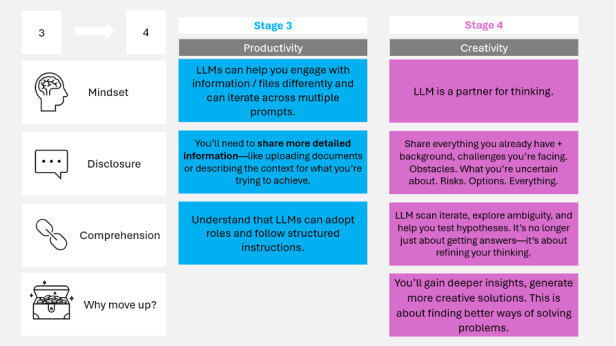
Level 4 is all about treating your LLM as a creative partner to find better solutions to existing problems.
Indicators You’re Ready to Move Up
You’re ready to transition to Stage 4 if:
- You’re comfortable using structured prompts to handle complex workflows.
- Your job involves you finding better solutions to existing problems.
- You’re engaging in iterative dialogues and explore ideas collaboratively.
Large Language Models and Creativity
Most professionals don’t consider themselves creative. That’s a problem.
Adobe did some research a while ago which suggested that less than half of people consider themselves to be creative. Most people feel like they’re under pressure to be more productive at work, rather than generate new ideas. Only one in four think they’re living up to their creative potential.
According to MIT, LLMs absolutely can help you be more creative. The job of senior leaders is often to cut through – to find ways to get themselves and their teams working smarter, not just harder. In simple terms, to ‘find a better way.’ LLMs can help you find creative new ways of solving your problems.
Those who can’t think creatively—or refuse to cultivate it—become liabilities in rapidly evolving systems. Especially those involving the development of AI. Leaders have a responsibility to embody the behaviours they want their team to live out.
Mindset Shift
To move to Stage 4, you need to be comfortable with everything from stage 3 – uploading files and relevant info. To use an LLM at Stage 4 is to admit that your best thinking might come from a conversation with something that has never been alive.
But now, you’ll be shifting your mindset from seeing the LLM as a tool for execution to treating it as a collaborator in your thinking process. You’re still in charge but your LLM is going to use what it knows to help you find creative solutions you never thought existed.
Imagine having a whiteboard session with someone who never gets tired, always has fresh ideas, and can see connections you might miss. The LLM can help you brainstorm, refine, and expand your thinking in ways that feel like a true partnership.
“This isn’t just a tool for answers—it’s a partner for thinking.”
Disclosure
At Stage 4, disclosure becomes more nuanced and personal. In addition to the elements of structured prompting you learned at level 3, To fully engage in collaborative reasoning, you’ll need to share:
- Not just what you think, but what you’re currently assuming is true. Stage 4 works best when you share the frames you’re not questioning. For example: “I’m assuming our customers won’t pay more than X,” or “I believe remote work reducesinnovation.” LLMs can only challenge your frame if they know you’ve built one.
- Disclose what happens if you’re wrong : The LLM’s recommendations can and should shift depending on how much is at stake and how much risk you’re willing to absorb.
- What are you optimising for : Speed? Elegance? Consensus? Radical change?
- Uncertainties or gaps in knowledge: What don’t you know? What are you unsure about?
“The more I share about my goals, challenges, and uncertainties, the more the LLM can help me think through them.”
Comprehension
At Stage 4, you begin to understand that the LLM isn’t just a source of answers—it’s a tool for exploring ideas. LLMs have been trained on the sum total of human knowledge. Now you’re using it to create possibilities.
This is the hardest part. Stage 4 will ask you to surrender some of your control of the output of your work for just long enough to discover something unexpected. It’s no longer “what I tell it to do” but “what emerges when I think with it.” Many people—especially senior professionals—will resist this because their identity is tied to being the smartest one in the room. Letting a machine surprise you means stepping down from that throne.
This involves:
- Extending the iterative dialogues where you refine ideas and explore possibilities that you started in Stage 3.
- Asking the LLM to test hypotheses, weigh options, and analyse trade-offs.
- Using the LLM to synthesise information from multiple perspectives or disciplines.
“I can use this to explore ideas I hadn’t considered before and refine my thinking through dialogue.”
At stage 3 thinking, you’re concerned about hallucinations and checking the work you produce to ensure the draft your LLM has given you is accurate when you finish it.
At stage 4, wrong answers can be a good thing. You’re exploring a topic and you specifically want to go in a new direction. Errors don’t matter while you’re ‘spit-balling’.
Why Move Up?
The benefits of moving to Stage 4 are transformative:
- Deeper Insights: By engaging in dialogue, you can uncover insights that go beyond surface-level answers.
- Broader Perspectives: The LLM can help you consider multiple angles, from operational to psychological to economic.
- Creative Problem-Solving: Collaborative reasoning unlocks new ideas and approaches that you might not have arrived at on your own.
Natural Concerns
- “What if it leads me in the wrong direction?”
- How to Manage It: Treat the LLM’s outputs as suggestions, not final answers. Use your judgment to evaluate and refine its ideas.
Challenges to Try
To practice moving to Stage 4, try one of these challenges:
- Explore a Hypothesis: Ask the LLM, “What are three reasons my project might fail?” Then, refine and solve each issue collaboratively.
- Analyse a Decision: Provide the LLM with a decision you’re considering and ask it to analyse the political, psychological, and economic implications of your options. What have you missed? What could you do better?
- Brainstorm Alternatives: Share a problem you’re facing and ask the LLM to generate multiple solutions. Then, work together to refine the most promising ideas. It doesn’t matter if 90% of them are thrown away – find the nugget of gold in the conversation.
- Example: My boss wants me to deliver the same training courses to all staff, to the same level of quality at half the cost. Help me explore the topic and find a way to do that.
Example Prompts
(Once you’ve provided the disclosure I described above.)
Here are some prompts to help you get started at Stage 4:
- “What are three innovative ways to address this challenge? Let’s explore the pros and cons of each.”
- “Here’s the context for a decision I need to make. What are the potential unintended consequences, and how can I mitigate them?”
- “What are three reasons this policy might fail? Let’s refine each one and explore solutions.”
- “What have I forgotten in my approach here?”
- “Is this problem unique to my industry? Or have you seen it elsewhere? How could I apply the ideas that solved problems like this in other industries or verticles?”
- “How could I make this problem much worse for myself?” (It might just prompt a realisation that takes you in the right direction.”
- “What could I ask you that would help me see the answer here?”
In Conclusion
Moving from Stage 3 to Stage 4 is one of the largest conceptual leaps you’ll make in your interactions with LLMs. It transforms your relationship with the LLM from a tool for execution to a partner for exploration.
Up to this point, many users still unconsciously treat the LLM as a glorified autocomplete. Collaborative reasoning forces you to grapple with the fact that this ‘thing’ is capable of synthesizing, reframing, and proposing—things we associate with humans.
By engaging in collaborative reasoning, sharing more nuanced information, and treating the LLM as a thinking partner, you’ll unlock deeper insights, broader perspectives, and more creative solutions. It will literally change the way you approach your job and life – for the better.
Perhaps the most dangerous thing you can do in an age of synthetic cognition is cling to solitary thought. If you are still working alone in your mind—you’re likely to be outperformed by colleagues and competitors.
It’s a big subject. If you’d like to read more about Stage 4 and engage with more example prompts and some further background on creative solutioning, read this article – The Third Axis.
In the next article, we’ll explore the transition from Stage 4 (Collaborative Reasoning) to Stage 5 (Advanced Engagement), where the LLM becomes a reflective partner for strategic and personal growth.
 Neil Aitken - Blog