The Idea in 60 Seconds
- At Stage 2, you started using LLMs for simple, practical tasks like summarising documents or drafting emails.
- Moving to Stage 3 (Structured Prompting) is about unlocking the LLM’s ability to help you produce more work, more quickly.
- The benefit to you is improved productivity.
- You’ll be outlining goals, constraints, context and other information to help the LLM help you.
- Critically for stage 3, you’ll be ‘kicking the ball around’ (having an ongoing conversation with the LLM around the work you’re trying to do.)
- This article explains how to make that shift, covering the essentials of Prompt Engineering, Collaborative Mindset, and Iteration/Recursion (kicking the ball around.)
Helping Users Move Through the AI Maturity Framework – Stage 2 to Stage 3
Stage 2: Tool/Query → Stage 3: Structured Prompting
At Stage 2, you’ve been using LLMs as a handy tool for straightforward tasks—asking it to summarise an article, draft a quick email, or generate a to-do list. But LLMs are capable of so much more.
Moving to Stage 3 is like upgrading from driving on a highway of predictable possibilities to piloting a sand buggy in a desert of ideas. You’re no longer constrained by the usual rules of what’s possible. Instead, you’re free to explore, experiment, and create – to move in any direction you want to go.
This is where Structured Prompt Engineering comes into play. A good prompt isn’t just a question—it’s a carefully crafted set of instructions that tells the LLM how to think, what role to play, and what constraints to follow.
Finally, in this stage, we will start experimenting with iteration, kicking the ball around with your LLM. When you master this, the LLM starts to feel less like a tool and more like a collaborator, helping you tackle bigger, more intricate tasks and saving you more time than you ever thought possible.
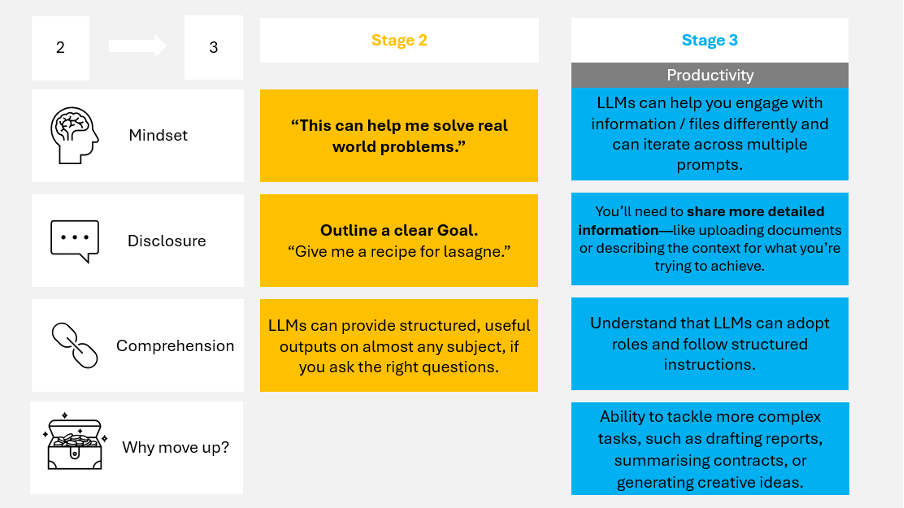
Stage 2 to 3 is where the magic happens. This is where you stop thinking of LLMs as tools and start seeing them as collaborators. You’ll get more work done more quickly and to a higher standard.
Mindset Shift: From Tool to Collaborator
To move to Stage 3, you’re exploring the opportunity to start seeing the LLM as a collaborator—a patient, highly skilled (but slightly literal) assistant.
Imagine explaining a task to a new colleague. You wouldn’t just say, “Write a report.” You’d provide details, context, and expectations. LLMs work best on that same level of clarity. The more context and clear instructions you give, the better the results.
Don’t be constrained by your own view of your own memory or abilities. You’re dealing with a machine here is a machine. Cut and paste relevant emails in to help it understand the situation. All of them ! It can take it ! Include whole reports if you think it will help. (Mastering uploading documents is a helpful skill to have at this level.) If you’ve mapped out ideas – put them in. The LLM will ignore what’s irrelevant and use what is to help provide a better output.
There is a lot of material out there on how to write a good prompt so we will cover only the basics here. Then we’ll get on to the mindset shifts you’ll undergo. That’s where the real value is.
The Basics of a Good Prompt
A good prompt is the foundation of success at Stage 3. There are a tonne of resources available on line. Google have a free course and a thorough document which outlines best practice. OpenAI (the company that makes ChatGPT) have an equivalent – although I found it slightly more technical than new users might fully benefit from.
Here’s what it should include:
- Act As:
- Assign the LLM a role. This helps it frame its responses more effectively.
- Example: “Act as my English teacher, Mrs O’Brien. She was 80 years old, Irish and had studied English for 50 years.”
- Goal:
- Be clear about what you want to achieve.
- Example: “Give me an idea that my boss will like but won’t result in too much work for me.”
- Constraints:
- Set boundaries or rules for the response.
- Example: “I’m tired—just give me bullet points.”
- Context:
- Provide background information to help the LLM understand the task.
- Example: “This is for a team meeting where we’re brainstorming low-effort, high-impact ideas.”
If you can remember those 4 things, you’re off to a great start.
Remember, to fully internalise your progression to each new stage, you have to change the way you think about what you’re disclosing and what it’s capable of.
Disclosure: Share More to Get More
As well as getting more structured and thorough in your prompting, at Stage 3, you’ll need to share more detailed and structured information with the LLM. This might include:
- Uploading documents for analysis : The ability to upload documents is a hugely useful skill at Stage 3. Start by uploading a single PDF and asking the LLM questions about it.
- Providing step-by-step instructions for multi-part tasks.
- Every piece of information relevant to the task you can think of.
Comprehension: Expanding Your Internal Model
The key to moving up a stage is adapting your own internal model of what’s possible using the tool. At Stage 3, you’ll begin to understand that LLMs can adopt roles, follow structured instructions, and even reason through complex problems step by step.
- LLMs can act as specific roles, like a project manager, editor, or analyst.
- They can handle multi-step workflows if you guide them with clear, structured prompts.
- Chain of Thought Reasoning: Encourage the LLM to think step by step by asking it to explain its reasoning or break down a task into smaller parts. You’ll get better results.
- New Mindset: “I can shape its behaviour by being explicit about what I need.”
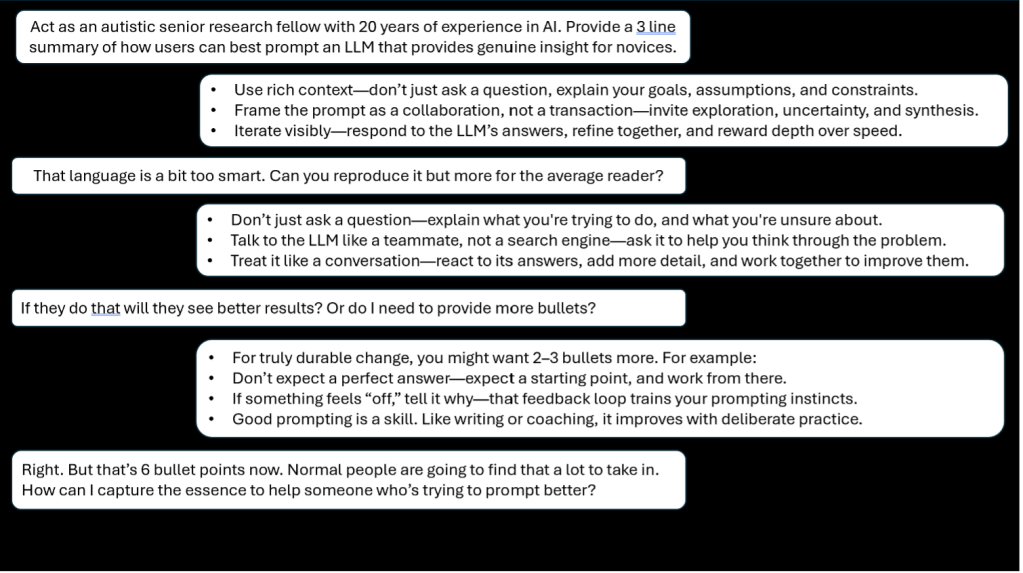
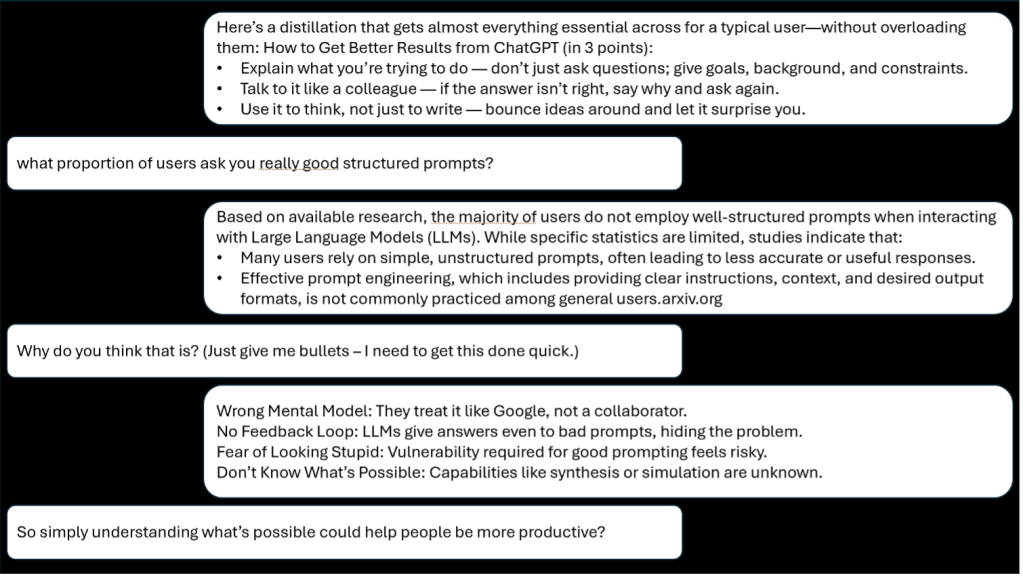
Kicking The Ball Around. Iteration
- I think of working with an LLM as ‘Kicking The Ball Around’ with the it. When you see the answer it gives you, discuss it. Which bits do you like, which would you like to revise. Explain why you feel that way to your LLM.
- Ask follow-up questions, challenge its assumptions, and guide it toward better results. Do you think it’s wrong? Tell it! Explain why.
Why Move Up?
The benefits of moving to Stage 3 are transformative:
- Higher-Quality Outputs: By providing more context and structure, you’ll unlock outputs that are more accurate, nuanced, and useful.
- Tackle Complex Tasks: You’ll be able to handle multi-step workflows, such as drafting reports, summarising contracts, or generating creative ideas.
- Save Time: Structured prompts allow you to complete complex tasks faster and with less effort.
- Example: Instead of just asking for a list of ideas, you can ask for a SWOT analysis of each idea, complete with pros, cons, and next steps.
Natural Concerns
- “What if I share sensitive information?”
- How to Manage It: Avoid sharing confidential or personal data. Use placeholders or anonymised examples to keep your information sec
Challenge to Try
This is where you put your new skills into practice. To move to Stage 3, try one of these challenges:
- Document Analysis: Upload a document and ask the LLM to identify the top three risks, provide supporting citations, and suggest mitigation strategies.
- Structured & Role-Based Prompt: Ask it to “act as a project manager” and create a detailed timeline for a project you’re working on.
- Chain of Thought Reasoning: Ask it to break down a complex problem step by step and explain its reasoning.
- Iterate : Ask it to summarise a document and then get it to reformat the answer as a bulleted list. Then with a friendlier tone. Then the first half scientific, second half humorous. You’re learning how to hone the results it provides so it gives you exactly what you want.
- Get it to ask you questions : LLMs are good at knowing what they need to know to do the job you want them to do. Try using that for your own advantage. Set it a goal – say ‘write me a one page brief for my boss on the latest iPhone.’ And then tell it ‘ask me as many questions as you need to, one at a time, so I can help provide you the information you need to achieve this goal.’
Example Prompts
Here are some prompts to help you get started at Stage 3:
- “Summarise this document in three bullet points, highlighting key risks and recommendations.”
- “Act as a project manager. Create a timeline for this project, including milestones and deadlines.”
- “Here are three ideas for a community engagement initiative. Perform a SWOT analysis for each idea.”
- “That’s not a bad first draft. I’d like to make the introduction punchier, remove section 2. The conclusion seems light. Provide 3 options for insight I could add that would help the user.”
Key Things to Remember
- Experiment Freely: LLMs are designed to handle all kinds of inputs. Every interaction is a chance to learn and refine your skills.
- Progress Takes Time: Each step forward unlocks new possibilities. Adjust your prompts, add more context, and watch your results improve.
- Start Small: You don’t have to dive into complex workflows right away. Start with simple, structured prompts and build confidence as you go.
- You’re in Control: The LLM is a tool, not a decision-maker. Use it to generate ideas, test hypotheses, or explore possibilities—but remember, the final decision is yours.
In Conclusion
Stage 3 is where the magic happens. By mastering Prompt Engineering, adopting a Collaborative Mindset, and embracing Iteration, you’ll unlock the full potential of LLMs. The key is to experiment, refine, and treat the tool as a partner in your creative and professional journey.
In the next article, we’ll explore the transition from Stage 3 (Structured Prompting) to Stage 4 (Collaborative Reasoning), where the LLM becomes a true thinking partner. Stay tuned for practical steps, challenges, and prompts to help you take the next step in your AI journey.
 Neil Aitken - Blog