The Idea in 60 Seconds
- When users first start using LLMs, they often engage with them for entertainment.
- That can look like asking playful questions, generating jokes, or exploring ChatGPT’s capabilities in a light-hearted way.
- (What they’re really figuring out with their questions is – ‘What is this thing?!’)
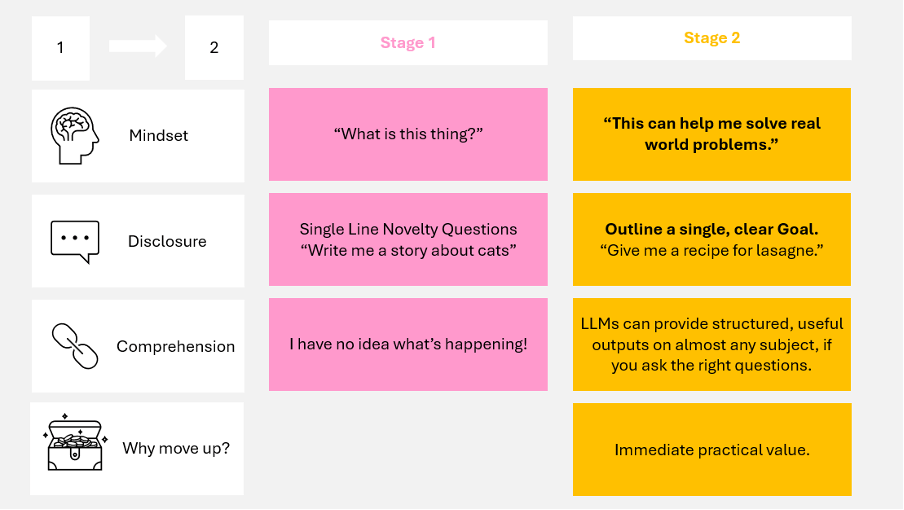
- Moving from Stage 1 (Entertainment) to Stage 2 (Tool/Query) is about recognising LLMs as practical tools that can help you solve real-world problems.
- This article explains how to make that shift, covering the mindset, disclosure, and comprehension changes you’ll naturally undertake, which will unlock the next level of ChatGPT’s capabilities for you.
Even for new users who feel like Large Language Models like ChatGPT could help them a lot, it can be hard to figure out just how to get there.
Stage 1: Entertainment → Stage 2: Tool/Query
At Stage 1, your interactions with LLMs are likely playful and exploratory. You’re testing the waters, figuring out what the tool can do, and having fun along the way. I asked ChatGPT what the most common questions new users asked and here’s what he said :
- Do you think you’re alive?
- What’s the meaning of life.
- Will AI take over humanity.
- What should I do with my life?
- Will I find love?
There’s a sad element to those questions I’ll ignore.
But LLMs are much more than entertainment and capable of much more than standard answers to these questions. they’re powerful tools that can save you time, streamline your tasks, and help you solve real-world problems. Unfortunately, users can get stuck here for weeks, not realising that they’re a few questions (to trigger their own understanding) away from being able to use these tools much more effectively.
Moving to Stage 2 is about making the first leap: recognising the practical value of LLMs and starting to use them for meaningful, everyday tasks.
Indicators You’re Ready to Move Up
You’re ready to transition to Stage 2 if:
- You’ve explored the LLM’s capabilities and are curious about how it can help with real-world tasks.
- You’re comfortable experimenting with simple, low-stakes requests. (Like the questions above.)
- You’re starting to see the potential for practical applications in your personal or professional life. Maybe you need help writing a letter, filling in a form or you just want to see where a bit more engagement with ChatGPT can help you.
Mindset Shift
Remember when you thought you didn’t need a mobile phone—and now you can’t imagine life without it? Or when Yahoo seemed like the best way to navigate the internet—until you discovered Google? LLMs, Large Language Models like ChatGPT are the same: general-purpose tools that can transform how you work and live once you realise their potential.
“This isn’t just for fun—it can help me save time on everyday tasks.”
Disclosure
Remember, to move up stages, you’re going to have to share more information with the tool. At Stage 1, you’re likely sharing trivial or playful inputs—things like “Tell me a joke” or “Write a poem about my dog.” You’re not giving the tool much information to work with there. Just the question itself. To move to Stage 2, you’ll need to start thinking just a little bit more. Stage 2 is all about sharing simple but meaningful tasks.
- What to Share:
- Ask it to draft a to-do list.
- Summarise an article or document.
- Generate ideas for a project or task.
“If I share real tasks, I’ll get real value in return.”
Comprehension
Part of evolving your understanding is also you updating your internal model of what you believe the tool can do. At Stage 2, you’ll begin to understand that LLMs are not just reactive. They’ve been trained on literally every idea humanity has ever written down. As a result, they can provide structured, useful outputs on almost any subject if you ask the right questions.
What to Learn:
- LLMs thrive on clarity. The more specific your request, the better the output.
- They can handle a wide range of tasks, from drafting emails to brainstorming ideas.
“If I ask clear, specific questions, I’ll get better results.”
“I can challenge this thing with some difficult requests and get amazing answers.
Why Move Up?
The benefits of moving to Stage 2 are immediate and practical:
- Save Time: Tasks like finding recipes, drafting emails, or summarising documents become faster and easier. It’s like a Google search but more tuned in to an answer that will address your specific needs.
- Reduce Effort: Let the LLM handle repetitive or time-consuming tasks so you can focus on what matters most.
- Unlock Value: You’ll start to see how LLMs can make your personal and professional life more efficient.
- Set the Foundation for Future Stages: Stage 2 is where you build the skills and confidence needed to progress to more advanced uses, like handling multi-step workflows (Stage 3) or engaging in collaborative reasoning (Stage 4).
Natural Concerns
- “What if it gives me the wrong answer?”
- How to Manage It: Start with low-stakes tasks. Double-check its outputs and build trust gradually.
Common Missteps For Someone Moving From Level 1 to Level 2
- Common Misstep: Expecting the LLM to solve existential questions or provide perfect answers to vague, open-ended queries like “What’s the meaning of life?” or “What should I do with my life?” These types of questions often lead to generic or unsatisfying responses.
- How to Avoid It: Treat the LLM as a practical assistant, not an oracle. Focus on specific, achievable tasks where it can genuinely add value—like summarising information, generating ideas, or drafting content.
Challenge to Try
This is where the rubber hits the road and you actually internalise the new skill you’re learning. To practice moving to Stage 2, try one of these challenges:
- Daily Schedule: Ask the LLM to create a daily schedule based on your tasks and priorities.
- Draft an Email: Provide a few key points and ask it to draft a professional email for you.
- Summarise an Article: Paste a short article or document and ask it to summarise the key points in three bullet points.
Stage 1 users tend to ask for answers. Stage 2 users begin to see that you can use the LLM to structure your thinking. To internalise your understanding here, start layering the questions you ask. You’re aiming for more structured thought.
- Layered queries : Instead of ‘give me a recipe for lasagna’ try ‘give me 3 lasagne recipes: One traditional, one optimized for cost and one vegetarian. Rank them by prep time and number of ingredients.’
- Different points of view : Instead of asking whether remote work is a good idea, ask ‘How would an economist, a psychologist and an environmentalist assess the value of remote work?’
- Provide more information : Instead of ‘Write me a cover letter’, cut and paste a job advert in to the chat window and ask ‘write me a cover letter for this job.’
- Systems thinking : ‘Whats the chain of events triggered when someone lodges a workers comp claims?’ or ‘Give me a checklist of things I would need to check as a podcast host before I intereviewed someone.’
- Constraints : ‘Write a poem that starts with despair and ends with hope. It must reference technology and nature but not use either word.’
- Get specific : Dare to ask it for exactly what you want ! Be specific and see how it does. ‘I sometimes procrastinate at work. List the most likely 3 causes I do it and provide 3 bullet points, of no more than 15 words, which show how I can manage my time better, given those reasons.’ (You might notice it has a tough time counting the words. Why not ask the LLM why it finds that so hard?)
Key Things to Remember
- It knows more than you think it knows
Try questions about simple things – like recipes. But also explore an area of interest or expertise you have so you can see how well it ‘understands’ the world. - It’s free to make mistakes
At this stage, you’re involved in low level experimentation. There’s no financial or time cost associated with ‘getting it wrong’ - It’s Okay to Ask for Help:
Try experimenting with the idea of a conversational interface. Everyone can chat. One of the most important realisations you can come to is that the LLM is going to try and answer any question you ask to the best of its ability. There are no stupid questions and sometimes, the most obvious question is exactly the one you should ask. Why not try asking the LLM ‘what thought provoking questions could I ask here which would help me understand your capabilities?’
In Conclusion
Well done for being prepared to give it a go. Moving from Stage 1 to Stage 2 is about recognising the practical value of LLMs and starting to use them for meaningful, everyday tasks. By adopting a new mindset, sharing real-world inputs, and asking clear questions, you’ll unlock the first layer of productivity benefits these tools have to offer.
After a while, it will become natural to layer queries, engage with the LLM to ask it for help, explore topics from different points of view, get specific on what you actually want and add constraints to your prompts.
Remember, this is just the beginning. The skills you build at Stage 2 will set you up for even greater productivity and creativity as you progress through the framework. So, start small, experiment, and see where it takes you.
 Neil Aitken - Blog