
The Idea In 60 Seconds
- The way people use large language models (LLMs like ChatGPT) is evolving.
- Initially seen as tools for efficiency and automation, LLMs are now being used for deeply personal and exploratory purposes.
- This article examines two emerging trends in how they are used.
- First, the ‘disclosure frontier’ – the types of information people are sharing with their LLMs.
- Second the ‘comprehension frontier’—and their implications for technology, ethics, and identity.
Emerging Patterns in LLM Use: Beyond Productivity
The Harvard Business review released some research about how people use LLMs, importantly, addressing the changes in behaviour between 2024 and 2025.
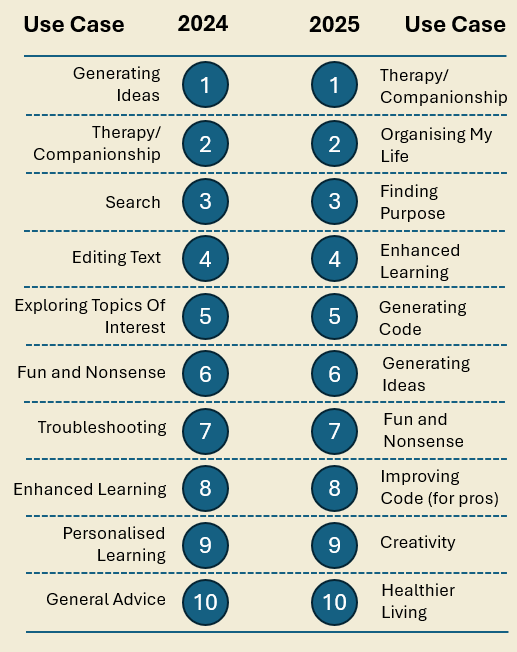
The Way People Are Using LLMs is changing over time.
It seems from the trends we can see in LLM use, people are progressing along two frontiers in parallel.
1. The Disclosure Frontier – “What I can’t say to others”
Shame, fear of judgment, cost barriers, or lack of safe relationships are all pushing users to LLMs for therapy, and to consider questions fundamental to their lives such as how they can establish their purpose.
What’s interesting about this is what they have to disclose in order to get useful responses in those areas of their lives – difficult emotions like shame, sadness, anxiety, guilt. Mental health concerns. Fears and insecurities.
Over time, increasingly, LLMs are being used as as a space for “what I can’t say to others”.
2. The Comprehension Frontier – “What I didn’t know this tool could do”
In parallel, users seem, over time, to push to explore LLM’s capabilities, either by accident or intuition, experimenting to ‘establish the size of the box’ and finding it is bigger than they had ever imagined. It’s a low risk activity in which the user receives immediate feedback on whether they succeed or fail.
As trust grows and results improve so, apparently, does their ambition. The individual has a private feedback loop but presumably word of mouth among friends and cultural changes as we get used to using LLMs more often almost certainly contribute.
This type of organic evolution of their use is a powerful driver of technological adoption, most often seen in people playing video games although the same happened with the internet, smartphones and Social Media.
Where Might That Take Us Personally and Professionally?
It’s likely that people’s LLM use will develop further along these two frontiers, leading to emergent behaviours and applications that even the tools’ developers might not have initially have envisioned. Obviously, these go further than productivity.
It’s not hard to imagine people evolving in to deeper and deeper emotional domains,LLMs becoming grief counsellors, legacy ethicists, death dialogue agents. It seems they offer an outlet for the fundamental human need people have for expression and exploration without judgment, similar to with how people often use anonymous online spaces or diaries, but now with a conversational, interactive element.
The core shift is from seeking advice to shaping a self, LLMs become scaffolds for personal ontology (a branch of metaphysics relating to examining the nature of being.) LLMs are helping us figure ourselves and our place in the universe out. That’s a far more intimate and influential relationship with technology than we’ve seen before. This moves AI beyond merely augmenting our abilities to potentially shaping our being.
In parallel, as comprehension levels rise, and people realise just how useful they are, LLMs will become generative cognition partners for work and life in general.Users will move from “ask-answer” to “build with” co-creating a great deal of their work. The research is clear. For many tasks, AI measurably, substantially increases creativity and output.
Ethical Implications
Of course this has ethical Implications of deep disclosure: While the “disclosure frontier” offers benefits, it also raises ethical concerns regarding privacy, data security, and the potential for manipulation or exploitation, especially when dealing with highly sensitive personal information. I’ve written before about fairness as the most important ethical value. Who decides how this increasingly revealing information is used ‘fairly?’
Philosophical Shift: From Instrument to Identity
It’s interesting to me that Social Media apps used AI in ways which are associated with mental health issues in younger people.
Most technologies extend the hand. LLMs have the potential to extend the self and the brain. Outside work, people are already using LLMs not for what they do but for who they can become while using them. At work, they’re beginning to understand what LLMs are capable of and use them to co-create – even co-creating their personal evolutions.
 Neil Aitken - Blog