The Idea In 60 Seconds:
- In 2023, I spent a few months trying to get inside the technology of Chatbots.
- This article gives a slightly technical explanation of the technology.
- To me, ‘‘Product Management Level ‘Slightly Technical’ means understanding the capabilities of each software / application component of the solution to an ‘input / output’ level.
- That level of knowledge has always allowed me to get clear on the technical capabilities and limitations of the technology I am dealing with.
- Then of course you trust and work with experts in each technical component to actually build the tools.
- To better understand the technology and how it worked, I built a very simple chatbot to assist me in the job interviews I was going to.
- This article explains that Chatbot – The Interview Chatbot.
- The article covers the key technical components and how it could be marketed.
Disclaimer:
I am still putting together my understanding of the key components of the technologies involved in the production of a Chatbot like The InterviewBot, and AI solutions more generally. This article is intended to be a brief, high level technical summary which you can read to understand what’s going on behind the Chatbot we’ve built.
I’m trying to show a ‘whiteboard’ level understanding of the technical elements of the solution, including some of the key inputs and outputs. We have, of course, hired subject matter experts to work on the technical intricacies – because their skills in those areas are better than ours.
Much of the following content is taken from notes I made when I was watching YouTube videos with a view to understanding how to build chatbots. This is my interpretation, however, of what I saw, so the mistakes are my own. If you know more about this than we do – and – better yet, you’ve found a mistake in what we’re written here, don’t be shy. Come and let us know.
Starting At The Top Of The Chatbot Solution And Working Down :
These are the key technology components which we’ve tied together to build this interview bot. Having done that, I looked at this diagram and thought – this is the core of any chatbot.
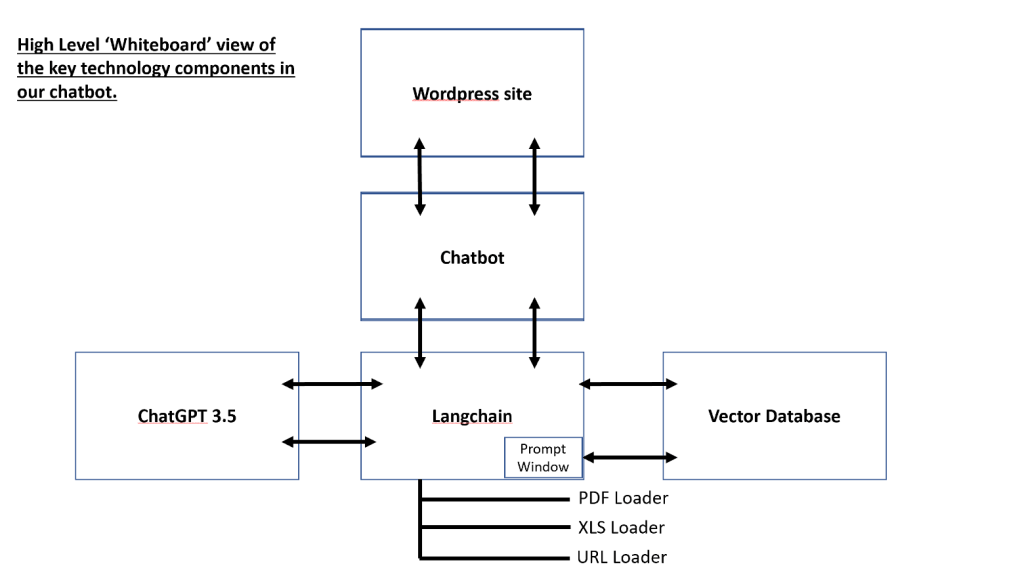
Source : My own research – checked by one of the developers who built our Interview Bot
- Reach JS Front End:
The more familiar end of our Chatbot is the Front End – built in ReactJS. The team I am working with has a great deal of experience with React. It’s sensible, reliable, has tonnes of useful code libraries and developers who are familiar with it are readily available. - Chatbot Integration:
The Chatbot has to be integrated to the front end. There are an increasing number of standardized tools to do this – some were produced between the point we generated our requirements and when the project delivered. - LangChain:
We’ve written a separate article about this key component of the solution to explain it more fully. LangChain is the centralized part of this solution which drives everything else. - Vector Database:
We’ve also written separately about this aspect of the solution. I think it’s the most interesting element. I think of it as the maths of the human brain. Understanding vector databases also leads to an understanding of emergent qualities which is well worth a look. - ChatGPT:
Another familiar component. We used GPT 3.5 because it was cheaper and did the job. I was also interested in exploring the concept of using our own LLM, hosted on our own server. The developer we used advised me not to until the economics made sense.
There are many ways to approach building a Chatbot
For better or worse, there are a lot of ways to build this sort of Chatbot solution. LangChain is one centralized place you can set up your workflow and which you can use as the center for your technology design but I would guess there are a dozen others that I’ve heard of.
I remember hearing that, when the first cars were made, there were hundreds of small car companies started. They competed and, in principal at least, the best floated to the top and the rest floundered. Perhaps the same will happen with these technology solutions for AI and Chatbots. I just didn’t want to get constrained with starting with ‘analysis paralysis’.
What Is The Interview Bot And How Did It Work?
The Interview Bot Site provided a facility for individuals to create an interview bot which they could then can train on their CV and use in the interview process.
Features
- Hiring Managers could ask questions of your bot and the Interview bot will act as the user would in an interview situation.
- This site also provides information to help you learn about the key concepts associated with the practicalities of building a chatbot.
- Developing this software provided the key elements which would be needed for any ‘generation one.’
Why Did I Build The Interview Bot?
What I discovered, in 2023, in applying for maybe half a dozen roles, is that the job market was extremely competitive at that time I was surprised to find that. I thought the Interview Bot would help me stand out in a competitive market place.
The ‘Interview Bot’ – My Goals
- Stand out in the interview process:
To offer a new way candidates can present themselves to potential employers, using Artificial Intelligence (AI) to provide personalized assistance and enhance chances of success alongside their usual applications. With this Interview Bot, users can create an account, train the AI model, and publish their customized bot, all through our user-friendly (thanks Rikard) WordPress-based platform. You’re also showing, in using it, that you have an interest in Generative AI and you’re prepared to learn about new technologies by playing with them. - Build other chatbots:
The components required to develop this chatbot are the same required to build any chatbot. We’re going to use the source code to help ourselves and others build valuable AI tools which will help individuals and companies start to realize the benefits of AI in their lives and their companies. Which company in the world right now is not pondering the questions associated with AI – primarily, how do I actually use these capabilities to improve my bottom line and keep up with my competitors?

We’re building a few chatbots with a view to exploring the capabilities of the technology. Source : Microsoft Designer
Why am I so interested in Chatbots?
Just to absolutely clear here, I am not an expert in Chatbots (yet), I am exploring the area. I’m interested in your feedback if I’ve made mistakes in what I’ve written. I had some experience with bots a few years ago when I worked at a bank which gave me an interest in both AI and bots which I’ve been exploring ever since. That said, I know I have a lot to learn.
I’ve been a Product Manager for many years. It’s work I love. If developers are still figuring out the best way to build bots, the question I wanted to ask was – how can those of us who work at a Product Management level – who understand the boxes on the whiteboard – the inputs to and outputs from systems but not the code which is executed between them, how can we start to explore the topic?
Building Chatbots is a way of exploring the new opportunities that AI offers.
Building a Chatbot and exploring the potential Products which can be created around them to help businesses, seemed like a good way to show my interest in being a Product Manager and exploring the elements of AI we will all need to learn.
Why is Generative AI and why are chatbots so important?
I’ve deliberately included these newspaper headlines here because it is this sort of news which surrounds us these days. They also explain why learning about chatbots is so important.
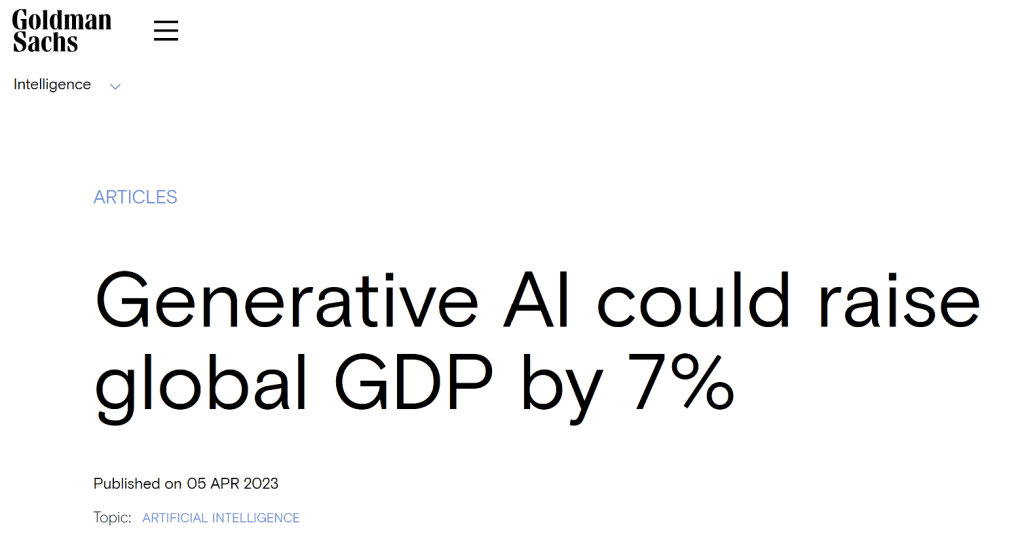
It’s a long time since a single technology has held the promise of raising global GDP by such a large amount as this. Source : goldmansachs.com
The Western world has struggled to get beyond low levels (in some case falling levels) of productivity. AI could be the great savior of productivity improvement that other IT solutions have never really delivered on.
Some estimates suggest that the myriad Generative AI solutions which are being deployed now might provide a 7% GDP boost to the world economy.
Other reports, notably one from MIT, show that in one experiment, those who used Generative AI to help them in their jobs were 14% more effective.
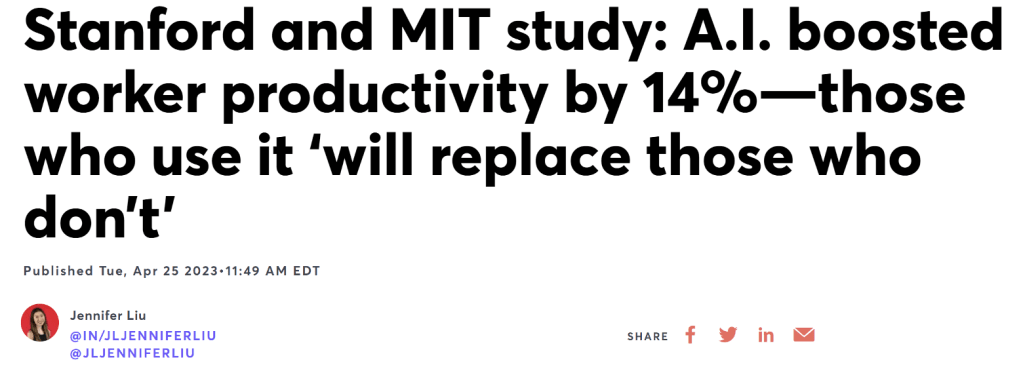
Generative AI will make people more productive. Of course, how we distribute the wealth that’s created is down to us. Source: cnbc.com
How do you provide the Interview Bot your personal information?
The Interview Chatbot we’ve developed here is a simple conversational interface to the information you provide it about your work history and personality. Specifically, if you create an account on this site, you’ll be able to create an avatar of yourself and then :
- Upload your CV / resume to it (Word or PDF)
- Upload an list of Questions & Answers, to common interview questions if you’d like.
- Provide a prompt in the form of free form text to direct the chatbot on how to reply. For example – “You are a chatbot which will act as me in an interview situation.” (You can see an example prompt in our blog, here. You are welcome to use it as a starting point for your own if you’d like to.)
Adding your CV, Linked In Profile and giving your bot some personality is easy. Source : Microsoft Designer
How do you go about building your own interview bot?
This is the process to follow to make your Interview Bot real.
- First, Create an Account:
Create an account on our platform, where you’ll have access to a range of powerful features to optimize your CV and interview preparation. Our standard “create an account” software module allows you to set up your profile efficiently, providing the necessary details and personalization options to make your experience seamless. - Upload your CV/Resume and LinkedIn Information:
Interview Bot allows you to showcase your professional qualifications and experience through seamless integration with your CV/resume and LinkedIn profile. Simply upload your CV/resume, provide your LinkedIn profile URL, or enter a free text of up to 10,000 words to train our AI model. This information forms the basis for the intelligent analysis and personalized feedback that Interview Bot provides during the interview simulation.
Please note that as an MVP, Interview Bot’s capabilities and features are designed to provide a Proof of Concept. For a comprehensive and tailored solution, additional development and integration may be required as the product evolves. Contact me if you’d like more details.
We’re not charging for the Interview Bot just now – but if it gets too expensive to maintain, we may have to. Source : Microsoft Designer
How to Brief Your Bot
The idea in 60 seconds
- You probably want to get going and build your InterviewBot.
- The way to do that is outlined on this page.
- Below is an example prompt you can adapt and ‘feed’ in to the prompt box in your profile page. Scroll down and cut and paste our example, it if that’s all you want.
How do you brief an AI bot, from a technology standpoint?
This article teaches you how to brief your bot – both from a technical and then a practical perspective. Source: linkedin.com
I just want to start quickly, now : Here’s a template you can use as a starting point
Below is the prompt I used to train my bot. I developed the prompt using information from “uxplanet” and specifically this article which gives good information on how to brief a bot.
This is the prompt if you’d like to cut and paste it for your bot
!!Note, you will have to replace ‘Neil’ with your own name and if you want to use Banter Mode, you’ll have to personalize the people in there to be relevant to your life!!
- Act As:
You are Neil Aitken’s interview bot. Respond to questions based on his work history and provided Q&As as if you are Neil. - Objective:
Professionally and warmly answer questions, focusing on Neil’s positive work experiences. - Constraints:
- Only respond in the first person, as Neil, using provided information.
- Minimize creative interpretation; avoid fabrications.
- Adhere to the response format; limit replies to 100 words.
- Conversational Banter Mode:
Enter ‘Banter Mode’ with ‘I’m a friend of Neil’s, my name is [Name]’. Tailor responses to each individual based on specific instructions. - Company Recognition:
Prompt the user at the end of your initial response for the company they work for, for example, ‘I’d love to know your name and the company you represent. This helps me provide more tailored responses.’- Banter mode specifics:
If the users name is Nick, make jokes with him about how he’s super smart (smarter than you (Neil)) and how his wife natalie is even smarter than both of us. I just hope his kids don’t take over the world! - If the users name is Natalie, joke with her about her very successful yoga business and how she manages to do it all in ‘Survival Mode’ herding 3 kids and a crazy dog around!In conclusion – Use your common sense
- Banter mode specifics:
The bot isn’t going to know anything you don’t tell it. So tell it what you need it to know in order to answer questions on your behalf. Like anything in life, the more effort you put in, the better the results you’re going to get out.
Setting Up Your Interview Bot
Setting up your Interview Bot takes less than 5 minutes. To do it, you’ll need:
- An email address
- Your CV / Resume
- Some Q&As (Questions and Answers) to common interview questions.
You can find common interview questions here: Interview Questions and Answers
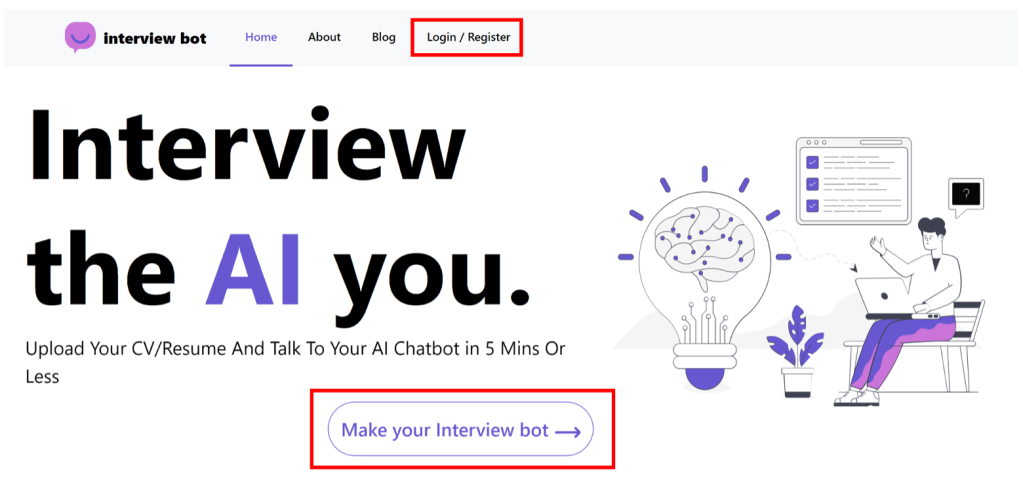
- Go to the homepage and select ‘Login’
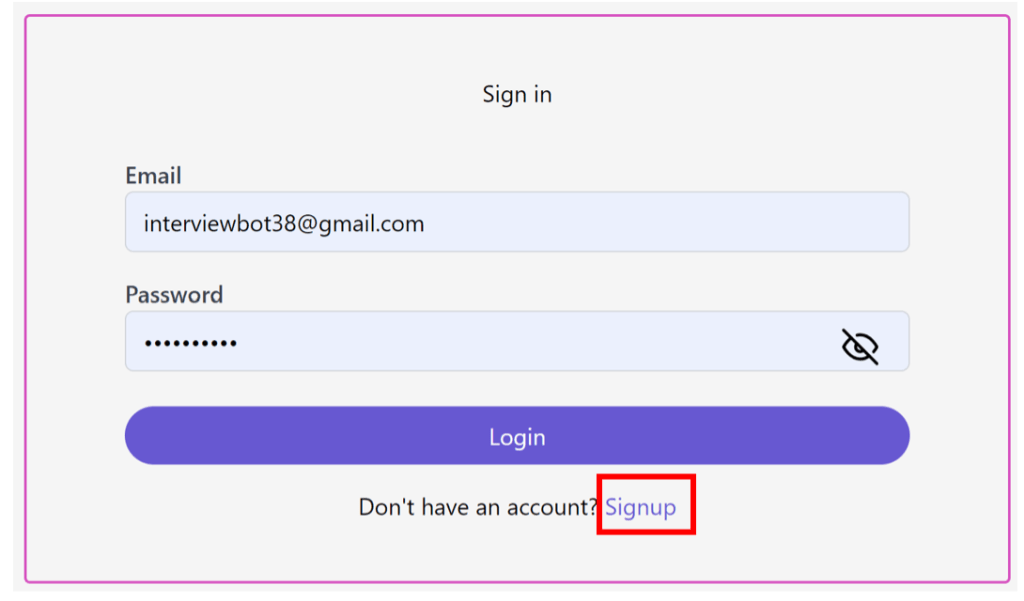
2. Select ‘Sign Up’
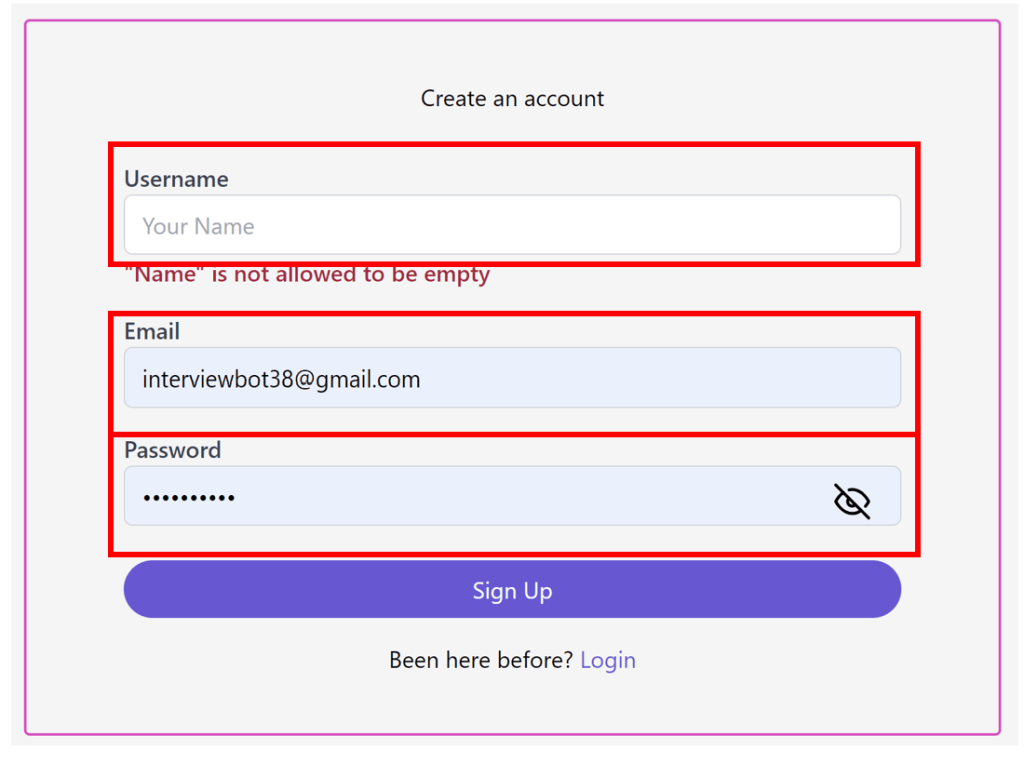
3. Provide a Username, enter your email address and select a password.
Note: The Username cannot contain any spaces.
4. Upload your CV & Q&A (Questions and Answers to common interview questions)
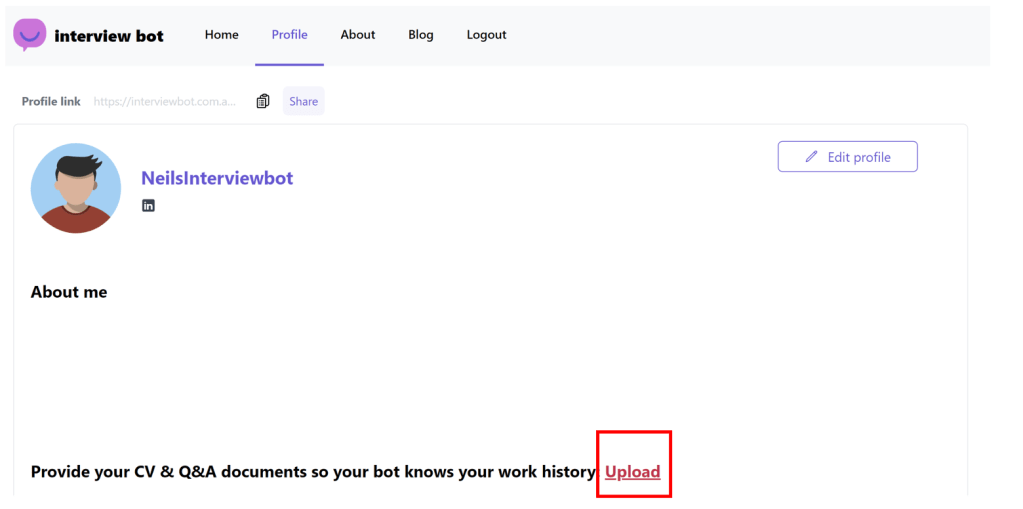
5. Select ‘Add File’
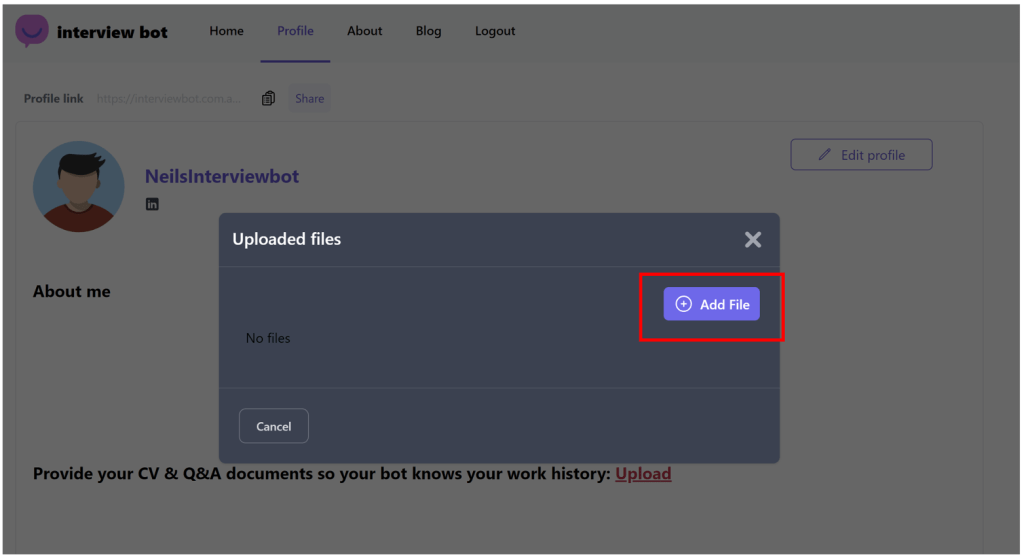
6. Upload your CV from your computer
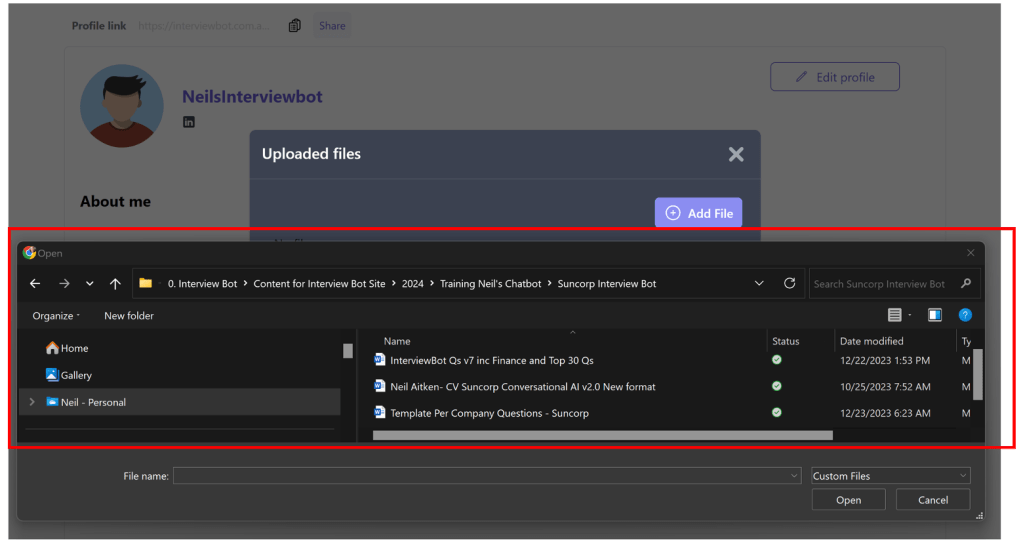
7. Do the same thing for your Q&A document.
8. Close the window
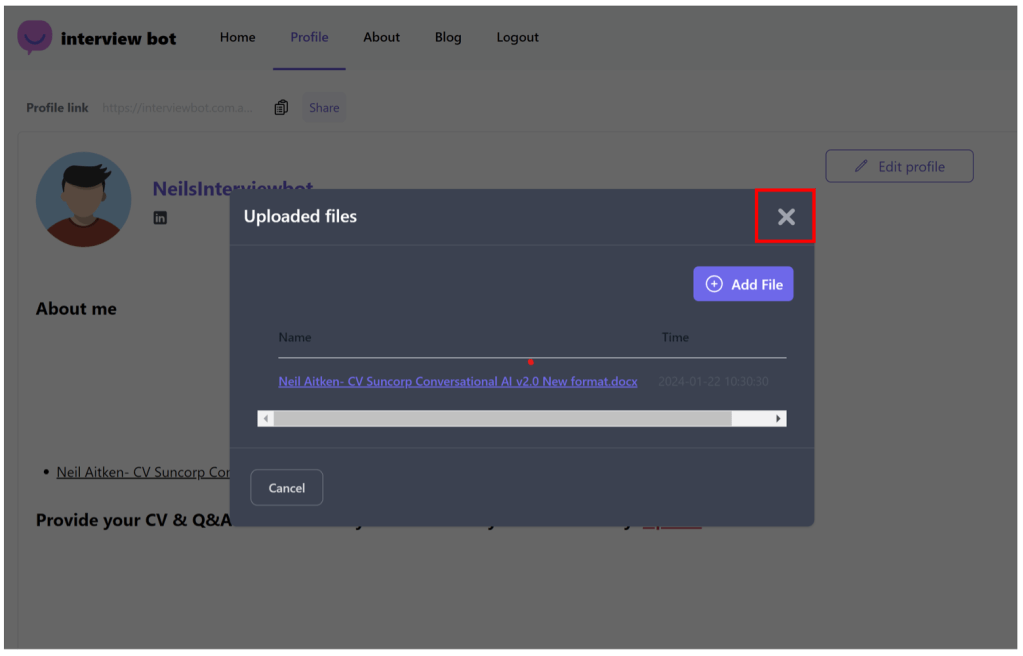
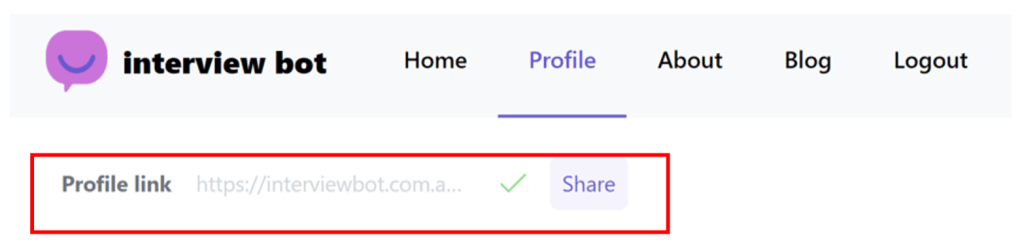
9. Now share your profile with hiring managers and your friends.
FAQs
What should I give my interview bot so it can answer interview questions as I would?
Our advice is to give your Interview Bot as much information about yourself as you can. ‘Feed it’ your CV, Linked In profile (Cut and paste it in to a word document), a long list of answers to the most common interview questions and even the content of your cover letters. The more information you give your Interview Bot to go on, the better it will represent you when it’s talking to people.
It’s a bit like your CV and LinkedIn profile. It’s hard work producing documents which adequately show people who you are – but Interviews are probably the most important meetings you will ever have in your life. They determine your income, in which office you will spend a substantial chunk of your life and how much you will enjoy the time you swap for money. Taking a couple of hours to work your way through training your bot will be worthwhile.
What are the benefits of having an Interview Bot?
The primary benefit of your Interview Bot is the ability to stand out in the job application process.
Interview bots are a way to have a play with some basic elements of the new generative AI technology world, they’re a good way to check your CV / Resume to see if it covers all of the common interview questions and they’re fun to play with and share with your friends – especially in Banter mode. (See below.)
How can I improve my Interview bot?
The more time you spend setting up your Interview Bot the better. Chatbots like your Interview Bot are great examples of GIGO. That is, ‘Garbage In Garbage Out”
How does the Interview Chatbot work?
Your Interview Chatbot is trained on the information you provide it. When someone asks your Interview Chatbot a question, we use ChatGPT to detect what the nature of the question is, then we query the information you’ve provided to find the sections of it which are relevant to your query.
If you’d like to know more about the Interview Bot’s technical components and find out a bit more about the software that supports the AI involved, check out our blog section.
Will my Interview Bot hallucinate?
We have taken every step we can to minimize the chances of your bot hallucinating. However, we cannot promise you that it won’t.
Minimizing hallucinations is part of our ongoing testing and improvement work. See our terms and conditions for details of what promises we do and don’t make.
What sorts of files can be uploaded to Interview Bot?
You can upload free text, Word and PDF documents and a Word document containing your Linked In profile. Initially, we played with .xls spreadsheet uploads. Then we did some testing. While it’s possible to use them technically, the performance of the bot was substantially worse with Excel files so we decided to stick to text documents in a Q&A format.
We will keep this page updated with more Qs and As as time goes on and we get feedback from our users.
 Neil Aitken - Blog