
The idea in 60 seconds
- Much of the talk of Generative AI has been to do with Business Applications.
- Since consumers make up about 60-70% of the economy, Consumer effects are likely to be more substantial than the effects we’ve witnessed so far on business.
- Additionally, Consumers are business’ customers.
- Changing Consumer demands change what businesses must do.
- Smartphones are a good way to communicate a new product to consumers.
- There are about 5 billion Smartphones in use around the world today.
- Google, Samsung, Apple, Open AI and some challengers have announced that they are building a mobile devices with Generative AI personal assistants built in.
- People don’t use personal assistants like Siri much now for a variety of reasons, mostly to do with the lack of situational /context awareness and lower than human levels of comprehension.
- In the very near future, both of these things they will produce improved contextual awareness and language comprehension and will, as a result, become our primary interface to the internet.
- At the bottom of this article, I trace announcements made after I wrote this page, which suggest either individually or collectively, progress towards the consumer effects I’ve outlined.
How Generative AI Will ‘get to’ Consumers – Smartphones
I’m interested in figuring out what will happen next to AI tools. This article is about the potential consumer use of Generative AI, delivered through Smartphones. I’ve written a separate article on how AI Assistants (link to my Article in this series on AI Assistants ) will affect existing businesses (link to impact on existing brands article in this series.)
Generative AI is not used as much as you might think at the moment. Perhaps surprisingly, only about 12% of Adults have used ChatGPT as of 2023. About 40% of people have seen it used by other people. Usage seems mostly concentrated in business and offices as opposed to our private lives. However, Consumers make up between 60% and 70% of most Western economies so there is every reason to believe that, as huge as the impact on the business world of Generative AI has been, the impact on Consumers will be larger still.
As of 2023, 5 of the 8 billion people on the planet currently have a smartphone. (Approximately 3.6 billion Android smartphone users and 1.46 billion active iPhone users worldwide.) Those that don’t have a smartphone don’t have much at all. Almost all of those devices has a voice assistant. Google call theirs an Google Assistant. Apple call theirs Siri. There is a fair case to be made that the easiest way to distribute an information product to the world is through a Smartphone.
We Already Have AI Assistants On Our Smartphones – Why Aren’t We Using Them?
Why don’t people use Google Assistant / or Siri very often?
- Privacy concerns: People are worried about their conversations being recorded and stored by companies like Google and Apple. There have been a number of cases of virtual assistants accidentally recording private conversations.
- Limited functionality: Virtual assistants are still relatively new technology, and they can’t do everything that people want them to do. Sometimes they get it wrong, particularly when they fail to understand and retain the context of the discussion. It can be frustrating for users, and it can lead them to give up on using virtual assistants altogether.
- Lack of integration: Virtual assistants are not always well-integrated with other apps and services. This can make it difficult for people to use them in their daily lives. For example, a virtual assistant may not be able to control settings on the same device, smart home devices or send messages through third-party apps.
- Cost: Some virtual assistants, such as Google Assistant, are available for free. However, others, such as Amazon Alexa, require users to purchase a device like an Echo speaker. This can be a barrier for some people, especially those who are on a budget.
- Lack of awareness: Many people are simply not aware of the benefits of using virtual assistants. There has not been a lot of marketing or promotion of these technologies.
Try and keep these in your mind. I will return to them later in the article.
What Google Apple and Open AI are doing around AI Assistants
Apple and Samsung both of which have played with their own versions of Clippy – Bixby and Siri.
- Google : Google sees Bard (their version of ChatGPT) as a way of adding intelligence to it’s personal assistant and turning it into one of what would then be 7 Google products which service more than a billion users.
- Apple : Much like Microsoft, is building AI in to all it’s software tools, Apple is trying to build it in to their iPhone The company has suggested that the upgraded version of Siri could be available as early as 2024.
- Open AI : “The iPhone of AI” OpenAI are working with Apple’s former chief design officer to create a consumer device. Experimenting with interactions which are less dependent on screens.
- Samsung : Revealed their own Generative AI model ‘Gauss’ in November 2023 and have a personal assistant on their Galaxy Device range called Bixby.
Some Are Betting Conversational Interfaces Will Replace Phones
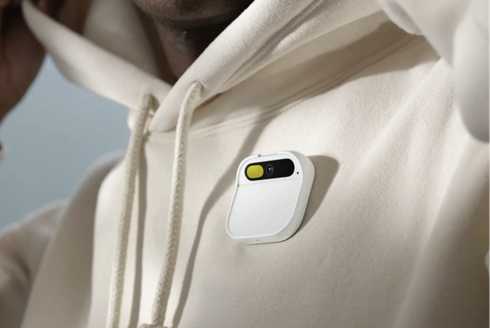
Humane AI’s Product Projects a screen when one is required.
Source :
There are other, smaller, startup companies staking bets that conversational interfaces will be important for consumers, too. This is a device from Humane AI. It’s designed to give users access to Generative AI models, starting with ChatGPT. It has built in camera, small projector. Hold an orange to it and it’ll tell you the calories and other nutritional info, too, apparently.
Remember, though, Conversational does not mean voice. You can converse with ChatGPT by typing and, given the amount of time we spend using our phones in public, we might very well prefer to converse in written form.
So, What’s Next For Devices ?
Very soon, Google, Apple and Open AI, as well as some new challenger brands are going to release new devices. Average tenure of device ownership has been increasing over time so a ‘killer’ new feature like a personal assistant on a phone will be a great way to sell more phones. They’re spending billions of dollars now doing what every company will soon have to do – linking User Interfaces experiences together across voice and screen.
Remember that list of reasons people don’t like to use Siri? (Privacy, Limited Functionality, Lack of Integration with other apps,cost, awareness.) The next generation of Generative AI and the conversational interfaces they provide solves every one of the problems that current Smartphone personal assistants like Siri present – except privacy. (And I’ve seen – as I am sure you have – billions of people sacrifice privacy for convenience and ‘free’ technology products. I’m one of the people who did it.)
These new devices will be designed around conversational (remember, not necessarily voice) interfaces and will be tied in not only to the devices functions as Bixby (Samsung’s PA) was but also to the Internet. They’ll be far more contextually aware, able to hold at least some level of context window (remember what you’ve said recently) and there will probably be a free version. (As well, potentially, as a paid version.)
In the short term, there will be some smaller benefits – less screen time means more battery. With screens accounting for 65% of a phone’s battery life, the introduction of voice-activated AI could extend battery life significantly, potentially offering two days of usage on a single charge.
Additionally, the simple amount of information available to a phone will give the Personal Assistant on your phone a great deal more utility. It knows how you’re feeling, how tired you are, what’s in your bank account and what you talk to your friends about. Which means the things it says to you could be mesmerizingly personal while also heightening existing privacy concerns.
All of which draws us to an obvious question. How will consumers with smartphones with AI Assistants interact with the Internet? I try to anticipate that in the next article.
News Articles Showing Pogress Towards the Consumer Effects I’ve Outlined
- Update 8.12.24 : The Google Pixel 8 Pro is now running Gemini Nano to power onboard Generative AI apps. More updates will be added to the Pixel family of devices in time.
- Update 4.1.24 : Financial Times – CEO of Qualcomm interview discusses sweeping changes to who has the power as Generative AI moves to Smartphones.
- Update 7.1.24 : Android code leak suggests a voice activated assistant capable of launching phone apps is under development with ‘hot words’.
- Update 7.1.24 : Samsung – Preview of major disclosure around AI in Galaxy devices. Announcement will be at CES in mid Jan.
- Update 11.1.24 : Rabbit voice interface between users and apps is announced. Watch the launch video here.
- Update 18.1.24 : Samsung include Google’s Generative AI in their new phone.
- Update 10.2.24 : Samsung sales are great – AI gives people a reason to upgrade their device sooner.
 Neil Aitken - Blog