Quick Intro
- Cancel Culture is a way of punishing people to maintain good behaviour in society.
- It can be a good thing in movements like #metoo.
- It can and often is used to censor others’ opinions.
- There’s a difference between the law of the land and the outrage some mobs generate.
- Critical Thinking is a valuable alternative to Cancel Culture.
What is Cancel Culture ?
The textbook definition is that Cancel Culture is a form of modern ostracization, where society casts out someone for ‘bad behaviour.’
‘Cast Out’ has a commonly understood definition. Getting Cancelled – being cast out – happens when people have crossed the line defined by a particular social group that’s considered essential and fall into their definition of ‘Bad’.
People tend to think of themselves as moral creatures capable of judging others. However, there’s a good argument to be made that acceptance is a better quality to seek in ourselves than (‘good’) judgement.
Cancelling is not all bad.
We all prefer to be in the ‘in group’ rather than the ‘out group’. When we’re part of a particular social collective, perhaps one defined by location, gender or skin colour, we might explicitly or implicitly define some rules about what is appropriate and what is inappropriate behaviour for ‘us’ and ‘them’.
Some of those ‘lines in the sand’ are important to us. If someone breaks the rules, we may react to their transgression by shunning them in those circumstances. That’s cancelling someone.
Publicly ‘calling someone out’ for contravening society’s ‘rules’ can be helpful. A good example is the #metoo movement. It has undoubtedly been a force for good in the world. Likewise, boycotting brands such as Nike to communicate that Western Consumers don’t want to buy clothes produced in sweat-shops shed light on an important issue and garnered useful change.
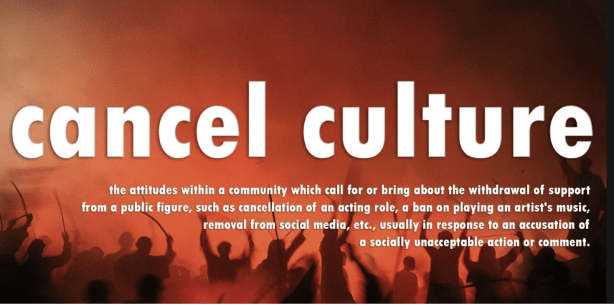
Source: Presbyterian Church
Cancel culture means different things to different people. To some, it is modern shaming. To others, socially acceptable bullying.
On the other hand, in some cases, Cancel Culture has been used as censorship. Everyone has always had an opinion. These days, Social Media provides a global platform for people to voice opinions and quiet the voice of the less popular, alternative thoughts.
Unfortunately, this is where things can go wrong. Cancel culture can represent a failure to think in more broadly considered moral terms. It can be about using tropes and words to produce power. Just because one particular group is louder (or only louder on one single platform) does not mean there is no value in listening to the opposite side of the discussion.
Outrage, Cancel Culture & Mob Rule
While calling out bad behaviour can be helpful, handing over control to the most vociferous voices is clearly at odds with how the world is supposed to work. Who decides, exactly, where to draw these lines in the sand? Who chooses who decides? Simple posts can spark enormous outrage. The Internet being what it is, ‘feedback’ can quickly evolve into bullying.
It’s possible that people – some individuals or social groups – have a worldview they’ve picked up from the news, social media, their education, or their family. Just because they hold the view doesn’t mean it’s true. In modern echo chambers, they and their friends discuss that and reinforce each others’ perspectives. Sometimes, they don’t consider the other side of the argument. The risk is then that people get Cancelled when they shouldn’t.
The turbulence of the mob is close to insanity, and, in some cases, people aren’t even interested in the facts of the matter being considered to inform their choice. In these circumstances, we run the risk of stifling free speech.
What’s the Alternative to Cancel Culture ?
Preferable, especially when it comes to ruining a reputation, is the rule of law or an open and honest debate. In everyday conversation, being open to hearing both sides of a discussion and keeping an open mind are table-stake elements of Critical Thinking.
People are considered innocent until proven guilty. It’s one of the most fundamental elements of our society, and for good reason. Laws are carefully considered and debated before they are implemented. Both sides of the argument are put forward before a decision is made. The best evidence is used to inform the judgement of transgression, and although it’s abstractly and indirectly, through voting or protesting, we can push back against laws we don’t like and don’t make sense.
Why does cancellation occur?
So far, we’ve covered the HoV and HVV models and looked at Cancel Culture. In the next article, I’ll look at the incentives in place to stimulate Cancel Culture – Clout – internet reputation points. Clout helps us understand the incentives and rewards which are in place for combining these models with Cancel Culture to wreak havoc on the Internet.
 Neil Aitken - Blog