
Quick Summary
- ‘Clout’ can be considered Internet Reputation points – for some, a measure of their own value.
- Outrage is an emotional (angry) response to a circumstance.
- Emotional responses drive engagement with digital services like social media, and anger drives action.
- As a result, outrage is, in many ways, the business model of websites like Twitter, Facebook and Reddit.
- One implication is that social media ‘trains’ users with ‘likes’ and ‘shares’ (Clout) to post content that generates the most outrage.
- More sophisticated Social Media users can employ the HVV / HoV frameworks to generate outrage and, therefore, Clout for themselves.
- Focussing on Cancelling famous people maximises a post’s impact on the Clout of the person who posts.
Why do people Cancel others? For Clout.
In earlier articles, I suggested that people use the Hierarchy Of Victims (HoV) and Hero, Villain, Victim (HVV) Models and Rules Of Thumb to help simplify the way they navigate a complex world.
There is still the question of why. Why do some people engage in this sort of ‘Cancelling?’ One incentive which drives the behaviour is ‘Clout.’
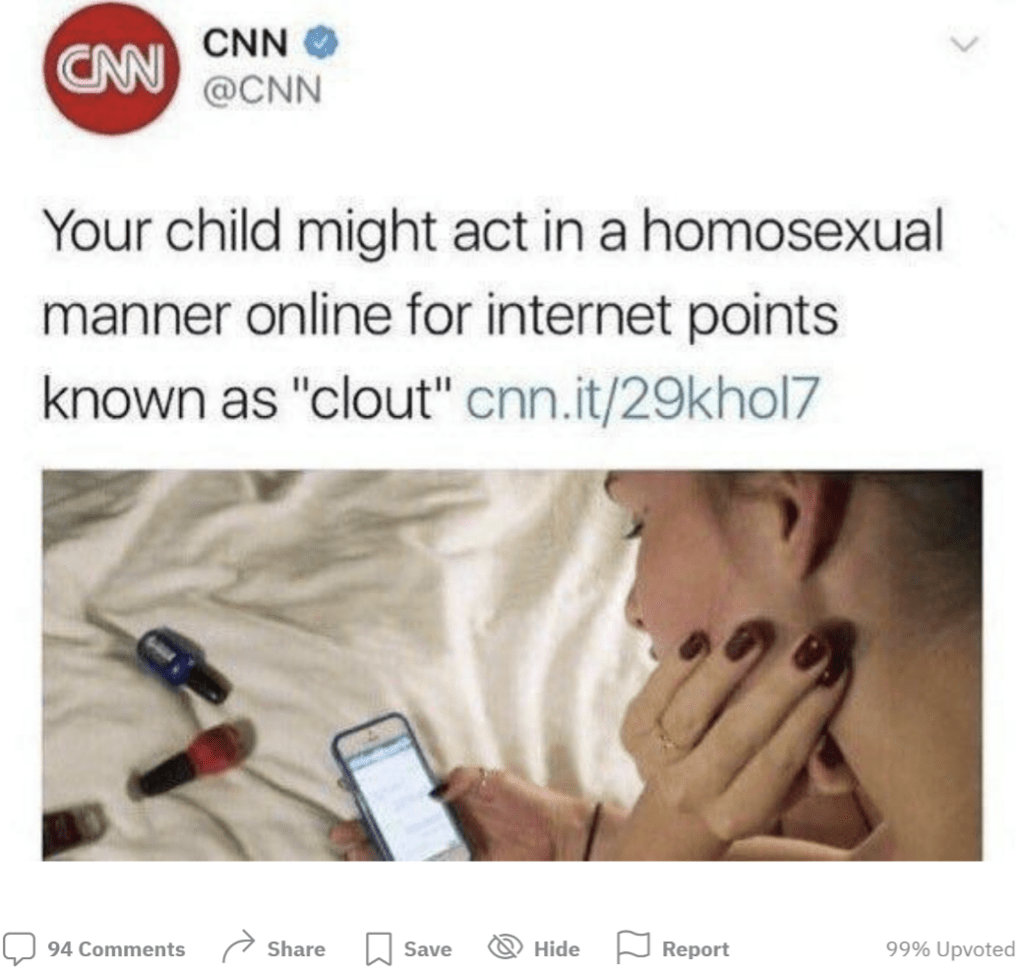
Source : CNN Social Media
Social Media is all about personal reputation – ‘Clout’. Some people like to turbo-charge their internet reputation points using the HoV and HVV models as part of a Cancel Culture.
What is ‘Clout?’ Why do people want it?
Clout is a form of Social Utility. It is the value of that good feeling someone gets when they improve their online reputation.
The value of reputation is, in some ways, the most critical asset we have. Others’ view of us feeds into how we see ourselves. Gathering clout improves the way many others online see us. That can make people feel good about themselves and where they sit in society when they get it.
We are a social species, and some evolutionary psychologists say that we spend our whole lives are the execution of a set of actions designed to create a personal brand which will help us get what we want. It’s why men buy Ferraris. It’s why women buy designer dresses and try to stay thin. It may be the root cause of almost any purchase you or I make.
In addition, people are (often) rational. They want to achieve their aims efficiently. The ideal solution to the problem of how to get as much Clout as possible requires only a tiny amount of energy but garners a lot of points. Luckily, Twitter and other social media sites provide an opportunity to secure just that.
Outrage is the business model
A well-put-together social media post can result in outrage. Outrage is a strong emotional response. Some Social Media posts are specifically designed to secure an emotional reaction from others. Some people who act out of anger online believe they are demonstrating their moral superiority – their anger is virtuous, so it can feel pretty good to be outraged.
Why seek to inspire outrage, though and not, for example, disgust? Some psychologists point out that anger is the most effective emotion to evoke online because it’s active. Anger makes people feel strong. If Social Media platforms were to trigger disgust in their users, those same users might turn their screens off and disengage. Social Media platforms want users to want to respond to what they see – to like, comment and retweet. Soliciting anger is the most effective way of securing that response.
An emotional connection created through outrage can cause people to stay on one platform rather than move their eyeballs to another. As a result, the business model of many of the social media sites we use each week depends, at least in part, on generating outrage.
New York University (NYU) conducted an analysis of half a million Tweets. They found that posts which included words which solicited an emotional response, including ‘war’, ‘hate’ and ‘racist’, enjoyed engagement 20% higher than equivalent posts which did not.
“Social media platforms like Twitter amplify expressions of moral outrage over time because users learn such language gets rewarded with an increased number of “likes” and “shares,” a new Yale University study shows.”
Source : A Yale University study
In effect, this model constitutes operant conditioning. The algorithms used by Social Media show and reward content which gathers outrage. The outrage can feed on itself. Cycles of outrage feed on each other. Importantly, outrage can be generated in the absence of the facts.
From Outrage to Clout in the realm of Social Media
In the pursuit of Clout, some people tie together the Hierarchy of Victims and Hero Villain Victim model, looking for ‘victims‘ online. Ideally, they want a victim who is as low down on the hierarchy of victims as possible.
We all want to associate ourselves with the good guys in stories and history. There is also an incentive to target famous people, make them the villain and yourself the hero. Criticising them is a way to reach a large audience – and maximise your Clout when you gather a crowd to make the famous person and get the credit for Cancelling their ‘bad’ behaviour.
After all, if a clear ‘Villain’ is found hurting a ‘Victim’, the world should be outraged. Highlight the offence! Put it on Social Media! Watch everyone pile on and destroy the Villain! (It’s worth noting that in some cases, the ‘victims’ don’t identify as ‘victims’ and have not asked for help from the Heroes who are prosecuting their case.)
What happens when we’ve generated enough Outrage?
Should enough outrage be generated, the Villain is then ‘Cancelled.’ Sometimes evidence is required, and sometimes it is not. (The requirement for evidence hinges on where this particular sits in the Hierarchy of Victims. )
Just where exactly is this fight we’re in?
People talk about divisive societal elements, far-left and right-wingers, misogyny and hate speech. I can only tell you that I don’t see any of that in my day-to-day life when I walk down the street. So why do we feel we are constantly part of a fight? We spend time on Social Media where that fight is presented to us.
With the right combinations of Hero, Villain and Victim, users can generate massive amounts of Clout in exchange for almost no effort, sometimes with a simple Tweet. This strategy can be highly effective with low risk, low effort, and a potentially huge Clout payoff.
A single user, with an accusation, can target a famous person as a Villain and receive Clout from a Global audience. To be successful, however, everyone must agree that the Villain is, indeed, a Villain. The idea is to accuse someone famous of being a Villain without evidence, never have to prove that they are a Villain and score maximum Clout points for doing so. This sort of activity has been around for quite some time. Harper Lee included it in her book, To Kill a Mockingbird, which is the subject of the next article.
 Neil Aitken - Blog