Hierarchy of Victims
- This is the first in a series of linked articles describing who gets ‘Cancelled’ and why.
- The articles will layer several psychology models to explain the Cancel Culture trend.
- The first model to explore is the Hierarchy of Victims – which I’ll abbreviate to HoV.
- The HoV uses a ‘points’ system to determine who is right in any situation, often before the facts are assessed.
- Society has decided that some ‘victims’ should be held in higher regard than others according to their social group.
- The language used around this subject aligns with this model – minority groups talk of punching down / punching up.
- The media, universities and humans’ readiness to use Rules Of Thumb all contribute to the prevalence of this idea.
How do we orient ourselves in the world – what’s important?
Some of what we think has been instilled in us by society without our consent. Together, through our behaviour, we create a culture. Sometimes, cultures have ideological components. An ideology is a set of ideas and ideals; Ideologies are what we think and what we think is important. When considering a course of action, our ultimate choices are determined by several influences. Culture and ideology are two factors at play when people are trying to figure out what to do about something.
‘In the old days’, we lived in honour/shame cultures. You can imagine a culture of that sort. For example, picture yourself in The Wild West or as one of a group of Victorian English Gentlemen 150 years ago. In those days, not so far past, insulting a man’s honour might result in being shot or challenged to a duel. What was important – one of the significant factors at play – the way people oriented themselves when a decision was made- was in securing and maintaining honour.
Over time, society moved on to competence cultures, in which confrontation was based on performance and facts. A competence culture is one in which people idealise meritocracies. If someone insulted you in this world, you’d ignore it and let your relationship with them fizzle. If they were out of line, you could sue them for libel. Being reasonable and working hard was important in competence cultures because that was the best way to get to the top.
Calvin makes me laugh because he says what I’m sometimes thinking and reminds me that perhaps my view, as a man, could be more informed than the instincts of a seven-year-old boy. Calvin and Hobbes
Our cultural norms have evolved (or devolved) once more these days. Some parts of society operate in a Victim Culture, which has replaced competency and honour cultures.
The Hierarchy Of Victims
Certain groups of people are designated victims simply because they are part of a group.
They might be Muslims or LGBTQ people or women, or another group distinguished by an arbitrary sociological feature. I am a heterosexual white male. I often hear about how toxic I am. My experience is that the media tells stories about how men like me are bad.
Who decides who the victims are?
In fact, some suggest it’s not just me who feels that way. The media have a part to play in influencing our ideologies and culture. One way they do that is by controlling the attention they give to particular groups of people in their coverage.
For example, it’s commonly observed that missing white women gain more media attention than any other group. Similarly, wildly different numbers of people have to die to warrant a news story, depending on where the deaths occur. (See chart below.)
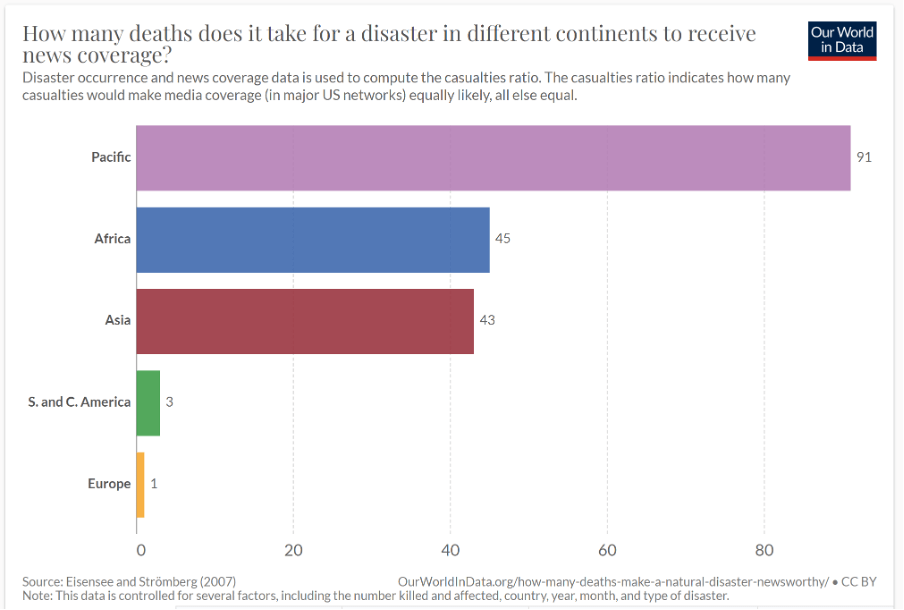
Media coverage of disasters suggests some bias in how they value ‘victims.’
Others believe that universities and other educational institutions influence culture and ideology by engaging in (or, for that matter avoiding engagement with) Critical Race Theory and Gender Studies.
There is some concern that some of these educational institutions
- position the curriculum as facts rather than opinions – or ideologies – and that those who graduate from the class then repeat what they have been told without critically reviewing it.
- View the world through a lens of conflict between groups (like men and women, for example) and how they interact within systems of privilege and oppression, thereby oversimplifying a complex issue.
- Limit themselves to the beliefs that white men created a system which advantages themselves and oppresses other minorities.
The human tendency to use ‘Rules Of Thumb’
Humans use approximations to make decisions because the world is too complex to understand everything fully. The hierarchies I’m describing here, whether from the media, universities or other sources, exist in some areas of society as ‘rules of thumb’ or ‘heuristics’.
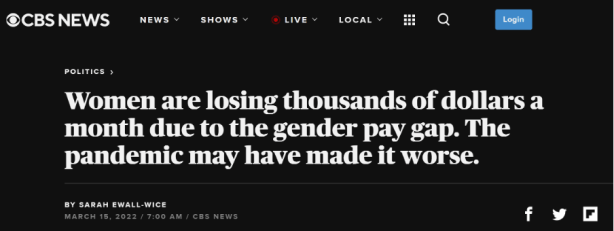
Headlines like this are misleading but cause society to form and maintain the belief that they are literally true. Some then use them as ‘Rules Of Thumb’.
The gender pay gap, for example, is often represented and accepted as fact. It’s a heuristic. However, most of the people I know believe it exists. They’re too busy to look into the issue, or they just accept it because everyone else does. To them, it’s undeniable, as a rule of thumb, to assume Women get paid less than men. I’ve looked into it in some detail, and, in my view, The Gender Pay Gap is of minimal value in understanding the nature of the difference in wages by gender. Nevertheless, the media reports it, universities teach it, and people believe it to be true.
Punching up vs punching down
Some words used to describe interactions between groups of people support the HoV model. Some groups (in the case of this article – trans people) ask others (in this case, Dave Chapelle) to ‘punch up’ rather than punch down.
Dave Chapelle has been accused of ‘Punching Down’, which indicates some commentators believe in the HoV.
The article I’ve linked makes an interesting point – one with which I don’t necessarily disagree; that good comedy has historically punched up. The suggestion is that comedy calls into question the behaviour of those in power and serves a valuable purpose in doing so.
My point in raising this is that the expression ‘punching up’ talks to an inherent belief in the minds of some of the people involved in these conversations that they are ‘lower’ than the comedians making jokes at their expense.
That said, however, any individual can hold a risible opinion. There is no HoV that we’re all the same and that jokes made at our expense should be taken for what they are – fun.
But it’s not always true.
I had a friend who served in the military in Iraq and Afghanistan. I clearly remember him telling me that the people there had nothing – no money – no food – nothing – but were very happy. Then I had an old housemate who lived in Australia. I won’t use his name here. He was a white male who, some ideologies would suggest, enjoyed privilege and power in life. Unfortunately, his father was an alcoholic who put cigarettes out on him. He was a genuinely nice guy, and I am incredibly sorry to say he took his own life at a very young age. I think of him often.
Whatever brings us together is good; whatever pushes us apart is bad. I believe what the Buddhists believe. Everyone suffers. Some are luckier than others, but establishing the social group where someone falls is an unreliable way of determining their struggle. We are all human.
In this article, I’ve Hierarchy of Victims and suggested that the media and educational institutions influence our culture and behaviour by giving us rules of thumb that are not always accurate. It’s not that some lives are worth less than others. It’s not that some are good and some are bad. We’re good and bad, and we have all been the hero, the villain and the victim at different times in our lives. It is to this idea I turn next.
 Neil Aitken - Blog